
How to Set Fitness Goals: 7 Steps That Actually Work (2026 Guide)
Wondering how to set fitness goals you’ll actually keep? Pick one clear target, break it into weekly habits you control, and track your progress. That’s the short version, and new research backs it up.
A 2026 expert statement from Exercise and Sports Science Australia says the popular SMART formula isn’t always the best fit, especially for beginners. This guide shows you how to set fitness goals in seven steps, with examples, formulas and a weekly review checklist.

Quick Answer: How to Set Fitness Goals in 7 Steps
- Find your why. Pick a reason that matters to you, not to anyone else.
- Check your starting point. Do a quick baseline test and look at your real schedule.
- Pick one main goal. Focus on one big target at a time.
- Match the goal type to your level. Beginners often do better with flexible goals.
- Build weekly habits. Focus on actions you control, like three workouts a week.
- Write an if-then plan. Decide when and where you’ll train.
- Track, review and adjust. Check weekly and revise every month or so.
What Is a Fitness Goal?
A fitness goal is a target you want to reach through exercise, such as running 5K, doing 10 push-ups or walking every day. It only becomes a real goal when you’re committed to it. A thought like “I should get in shape” is just an intention.
You don’t need January to start. A race, a wedding or a holiday can all work as a deadline.
Why Most Fitness Goals Fail
Most fitness goals fail for ordinary reasons, and they’re fixable. Knowing how to set fitness goals the right way starts with spotting these traps:
- They’re vague. “Get fit” has no finish line.
- There’s no bridge to your week. Wanting a result isn’t the same as knowing Tuesday’s workout.
- They’re all-or-nothing. One missed session feels like proof the plan is ruined.
- They start too hard. The routine is too advanced for your current fitness.
- They lean on motivation. It spikes early and fades.
The January Drop-Off
Strava’s data points to mid-January as the moment activity drops, a day it nicknamed Quitter’s Day. But the picture isn’t all bleak.
In January 2026, Apple reported an analysis of about 100,000 people in its Heart and Movement Study over four years. Apple Watch users raised their exercise in January and kept it up past Quitter’s Day. That’s Apple’s own data from watch wearers, so treat it as encouraging, not universal.
What the Latest Research Says About Goal Setting
The biggest update is the ESSA expert statement, published in Sports Medicine on January 8, 2026 (Swann et al.). It reviews decades of research on setting fitness goals and makes five useful points:
- Goals work. A meta-analysis found a medium effect on physical activity (d = 0.55).
- Any goal beats no goal. Even a vague one like “be more active” helps.
- Specific isn’t required. Goals didn’t need to be specific to work for inactive people.
- Timeframe matters. Daily goals, or daily plus weekly goals, worked. Weekly goals alone didn’t.
- Feedback helps. Goals work better when you get feedback or track your own progress.
Are SMART goals good for fitness?
Sometimes. SMART goals can help people who are already active and know what they’re doing. But the ESSA authors point out that SMART came from a 1981 business article by George Doran, which didn’t draw on exercise research.
They also found 34 different versions of the SMART terms in physical activity studies. For beginners, a rigid target can add pressure. Use SMART as a checklist, not a rule.
Types of Fitness Goals
The ESSA statement counts over 20 types of goals. These six matter most for exercise:
| Goal type | What it focuses on | Example |
|---|---|---|
| Outcome | The end result | Lose 10 pounds |
| Performance | A personal benchmark | Run 5K in under 30 minutes |
| Process | Actions you control | Train three times a week |
| Learning | Gaining skill or knowledge | Practice a squat with good form |
| Open | Exploratory, graded results | See how far you can walk in 20 minutes |
| Range | A flexible low-to-high target | Exercise three to five times a week |
Should you set outcome goals or process goals?
Use both, but lead with process goals. An outcome goal gives you direction, and process goals give you something to do today. In a six-week exercise study (Wilson and Brookfield, 2009), people with process goals stuck with exercise better than those with outcome goals or no goals.
Which Goal Type Fits You?
When you’re learning how to set fitness goals, your experience level changes the answer.
- New or returning to exercise: Try open, learning, process or range goals. In walking studies, inactive adults walked farther with open goals than with SMART goals. One participant in an open-goals trial said it “took away the trauma of failing.”
- Already active: Specific, challenging goals tend to work best. For example, deadlift 135 pounds for five reps in 10 weeks.

Step 1: Find Your Why
Write down why you want to train. Goals tied to feeling healthy, strong or energetic tend to meet needs like autonomy and competence. Goals based only on appearance are less likely to.
Try finishing this sentence: “I want to ____ because it helps me ____.”
Framing matters too. In a large experiment on New Year’s resolutions (Oscarsson et al., 2020), approach goals like “run three times a week” did better than avoidance goals like “stop being out of shape.”
Step 2: Check Your Starting Point
A goal should match where you are today. These four tests need no equipment:
| Test | How to do it | What it shows |
|---|---|---|
| One-mile brisk walk | Time it at a challenging pace | Cardio fitness |
| Push-ups | Count good-form reps (knees are fine) | Upper-body strength |
| Bodyweight squats | Count good-form reps | Lower-body strength |
| Sit-and-reach | Reach toward your toes, legs straight | Flexibility |
Then look at your real life. How many days can you train? What equipment do you have? What do you actually enjoy? A goal built around an activity you hate won’t last.
The CDC says moderate activity is safe for most people. Check with a doctor first if you have a health condition or new symptoms.
Step 3: Pick One Main Goal
Choose one main goal for the next 8 to 12 weeks. The ESSA statement warns that too many difficult goals at once can cause stress and pressure.
How many fitness goals should you set at once?
One main goal plus one or two supporting habits. For example, the main goal is to run 5K without stopping, and the habits are to run three times a week and stretch after each run.
SMART Fitness Goals: What to Keep and What to Skip
If you like SMART fitness goals, keep the parts that help:
- Specific: Name the activity, like running 5K.
- Measurable: Pick a number, like three runs a week.
- Achievable: Make it challenging but doable.
- Relevant: Tie it to your why.
- Time-bound: Choose a date, but also set a daily or weekly action.
Here’s a vague goal turned into one of the SMART fitness goals: “Get stronger” becomes “Deadlift 135 pounds for five reps in 10 weeks.” Doran himself said not every goal needs all five criteria, so don’t force it.
Step 4: Turn Your Goal Into Weekly Habits
Process goals are the weekly actions that make an outcome goal almost inevitable.
| Outcome goal | Weekly process goals |
|---|---|
| Run 5K without stopping | Run three times a week and add two minutes each week |
| Do 10 full push-ups | Do three bodyweight sessions a week with push-up progressions |
| Lose 10 pounds | Walk 30 minutes five days a week and strength train twice |
| Improve flexibility | Stretch for 10 minutes after every workout |
Formula: Weekly minutes = sessions per week × minutes per session
The CDC’s adult guidelines call for at least 150 minutes of moderate activity a week (30 minutes × 5 days) plus two days of muscle-strengthening. Moderate means you can talk but not sing.
A CDC sample week looks like this: brisk 30-minute walks on Sunday, Monday, Tuesday, Thursday and Friday, with weight training on Wednesday and Saturday. That’s 150 minutes plus two strength days.
Step 5: Write an If-Then Plan
Decide exactly when and where you’ll train. This is called an implementation intention.
Template: When [cue], I will [action] at [place].
Example: “When I finish my coffee on Monday, Wednesday and Friday, I will do a 20-minute workout in my living room.”
It works. In a 2002 study of 248 people (Milne, Orbell and Sheeran), 91% of those who wrote a when-and-where plan exercised weekly. Only 35% of the control group did. A later meta-analysis by Gollwitzer and Sheeran found a medium-to-large effect (d = 0.65) across 94 studies.
Step 6: Track Your Progress
Goals without feedback don’t work well. Pick a tracker you’ll still open in week three.
| Tracking option | Ease | Best for |
|---|---|---|
| Fitness app | High | Busy people who want reminders |
| Notebook | High | Screen-free, simple logging |
| Spreadsheet | Medium | Data lovers tracking strength |
| Wearable | High | Steps, heart rate and sleep |
Log sessions completed, minutes, weights and reps, and how you felt. Progress photos and measurements can help too, if they suit your goal.
Step 7: Review and Adjust
Do a quick check-in every week and a deeper review every four to six weeks. Ask three questions:
- Am I on track?
- Does this goal still matter to me?
- Is this plan sustainable?
If you keep missing sessions, shrink the habit, not the dream. If you hit the goal early, set the next one right away. That’s how to set fitness goals you can keep for years.
Fitness Goal Examples
| Goal | Outcome version | Weekly process goal | Flexible version |
|---|---|---|---|
| Get active | Walk 30 minutes without stopping | Walk 10 minutes after lunch, five days a week | See how many minutes you can walk today |
| Build strength | Do 10 full push-ups | Three bodyweight sessions a week | Train two to three times a week |
| Run 5K | Run 5K without stopping | Run three times a week | Run 20 to 30 minutes, three to four times a week |
| Lose weight | Lose 10 pounds | Walk 30 minutes five days a week | Lose about 1 to 2 pounds a week |
| Flexibility | Touch your toes | Stretch 10 minutes after workouts | See how far you can reach each week |
| Daily movement | Reach 7,000 steps | Walk after two meals a day | Beat yesterday’s steps when you can |
10,000 steps is a round number, not a rule. Studies summarized by HealthDay found benefits from roughly 4,000 to 10,000 steps a day.
Weight Loss Goals: The Calorie Math
The CDC says people who lose weight at a gradual, steady pace of about 1 to 2 pounds a week are more likely to keep it off. It also notes that a 5% loss for a 200-pound person (10 pounds) can improve blood pressure, cholesterol and blood sugar.
Here’s the math:
- Daily target = TDEE − daily deficit
- Weekly change (lb) ≈ (daily deficit × 7) ÷ 3,500
- Weeks to goal = pounds to lose ÷ pounds per week
Example: with a TDEE of 2,000 and a 500-calorie deficit, your target is 1,500 calories. That’s about 1 pound a week, so a 10-pound goal takes roughly 10 weeks. Find your own number with the TDEE calculator.
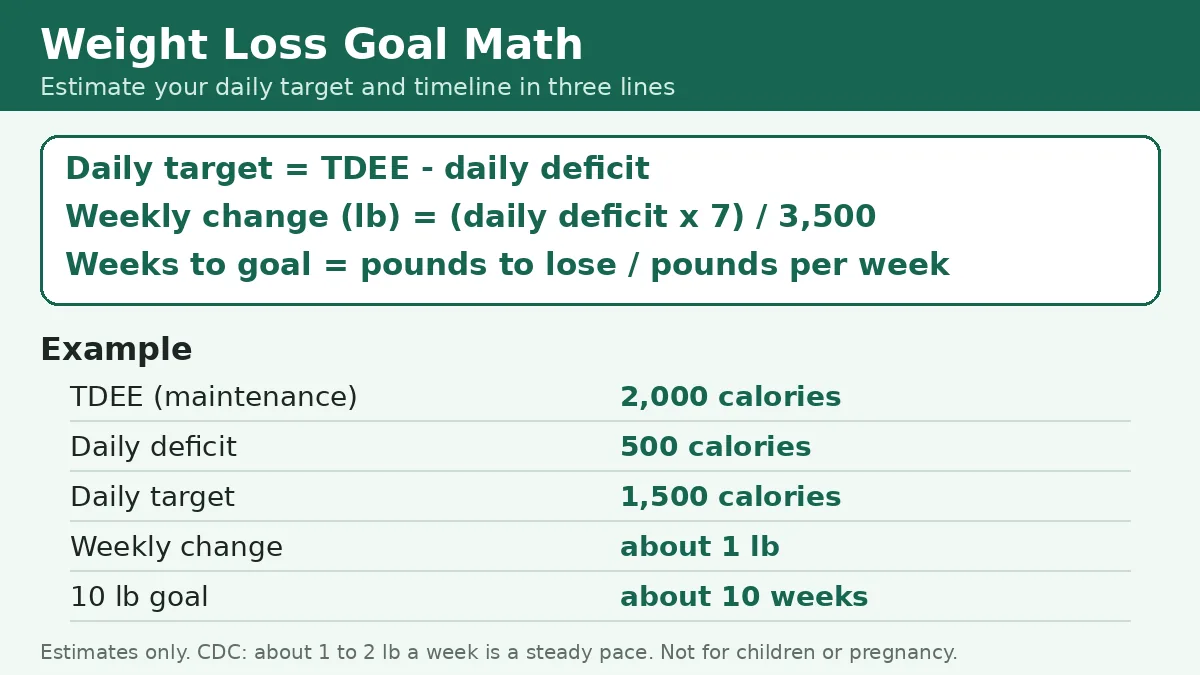
These are estimates, and real results vary. To pick your deficit size, read what your calorie deficit should be. For the step-by-step method, see how to calculate calorie deficit.
Standard adult estimates aren’t suitable for children, pregnancy or breastfeeding. If a medical condition or a history of disordered eating affects your needs, get individual guidance first.
Short, Medium and Long-Term Fitness Goals
| Timeframe | Focus | Example |
|---|---|---|
| This week | Daily habits | Walk 30 minutes on five days |
| 4 to 6 weeks | A benchmark | Run two miles without stopping |
| 3 to 6 months | Your main goal | Complete a 10K |
| 12 months | Long-term habit | Stay active three times a week all year |
Remember the research: set a daily action even when your target is weekly.
How Long Does It Take to Reach a Fitness Goal?
Expect weeks to months. For habits, a University College London study of 96 volunteers (Lally et al., 2010) found a median of 66 days to become automatic, with a range of 18 to 254 days. Exercise took longer than eating or drinking habits in that study.
For weight, the CDC’s pace of 1 to 2 pounds a week puts a 10-pound goal at about 5 to 10 weeks. Your timeline will depend on your body, your plan and your week.
How to Stay Motivated When Progress Slows
- Tell someone. A friend or coach makes quitting quietly harder.
- Find a workout partner. Shared plans are easier to keep.
- Set reminders. Notes, app alerts and calendar blocks all work.
- Reward milestones. Try new gear, a massage or a favorite activity.
- Skip the comparison. Your sleep, stress and history aren’t theirs.
- Make it easy. Lay out your workout clothes the night before.
Common Fitness Goal Mistakes
- All-or-nothing goals. “Exercise every day” breaks on day two. Use a range instead.
- Outcome-only goals. Without weekly habits, an outcome goal is just a wish.
- Ignoring your starting point. Match the difficulty to your current level.
- No feedback loop. If you don’t track, you can’t adjust.
- Never revising. Injury, travel or a new schedule means updating the plan.
What to Do When You Miss a Workout
Do a smaller version the same day or the next. Ten minutes counts. The Lally study found that missing a single opportunity didn’t materially affect habit formation.
Skip the guilt. Ask what got in the way, then change the plan to fit your real week.
When to Get Professional Help
Talk to a doctor before big changes if you have a health condition. A trainer can build a plan and keep you accountable, and a dietitian can help with food goals.
The ESSA authors also note that goals can add stress, and for some people may worsen mental health symptoms. If goal setting leaves you anxious or ashamed, switch to flexible goals and talk to a professional.
Fitness Goal Setting Checklist
- I can say why this goal matters to me.
- I know my starting point.
- I have one main goal.
- I have a weekly habit I control.
- I know when and where I’ll train.
- I have a way to track progress.
- My review date is on my calendar.
Frequently Asked Questions
What is a good fitness goal for beginners?
Start with a flexible process goal, like walking 10 minutes after lunch five days a week. It’s easy to start and builds confidence. Add specifics once you feel more skilled.
How do I set fitness goals for weight loss?
Choose a gradual pace of about 1 to 2 pounds a week, set a daily calorie target from your TDEE, and add weekly habits like walking and strength training. Track your progress and adjust monthly.
How often should I review my fitness goals?
Check in weekly on your habits and review your main goal every four to six weeks. Review sooner if you get injured or your schedule changes.
Is it okay to change my fitness goals?
Yes. Life changes, and flexible goals last longer. Update your habits rather than dropping the whole plan.
How do I stay motivated to reach my fitness goals?
Use weekly habits, tracking, a clear when-and-where plan and someone to share progress with. Motivation fades, so lean on structure.
What should I do if I hit my goal early?
Set the next goal right away. Choose a slightly harder target or a new skill so your momentum doesn’t leak out.
Do I need a personal trainer to set fitness goals?
No. You can do it on your own with the steps above. A trainer is a helpful extra for accountability, technique and a tailored plan.
Conclusion
Knowing how to set fitness goals comes down to a few moves. Find your why, check your starting point, pick one main goal, and turn it into weekly habits with an if-then plan. Then track, review and adjust.
Start small, stay flexible, and let the research guide you: any goal beats no goal, and the best one is the one you’ll keep doing.
Sources Checked
ESSA expert statement on goal setting (Swann et al., Sports Medicine, January 2026); CDC adult physical activity guidelines; CDC Steps for Losing Weight; McEwan et al. (2016) meta-analysis; Wilson and Brookfield (2009); Milne, Orbell and Sheeran (2002); Gollwitzer and Sheeran (2006); Lally et al. (2010); Oscarsson et al. (2020); Apple Heart and Movement Study analysis (January 2026); Strava Quitter’s Day coverage; HealthDay step-count summary.
This article is for general information and isn’t medical advice. Talk to a doctor before starting a new exercise or diet plan.
About the Author
Norman — Norman is a fitness writer specializing in physical health, exercise, strength training, and overall wellness. He focuses on making fitness information easy to understand, helping readers build effective workout routines, improve physical performance, and develop sustainable healthy habits.
One Comment