
How to Calculate Calorie Deficit: A Step-by-Step Guide for Weight Loss
Written by Elise Ava · Last reviewed 21 October 2026
If you want to know how to calculate calorie deficit the right way, the good news is the whole method fits on one page. To calculate calorie deficit for weight loss, you find your maintenance calories (TDEE), choose a deficit size inside the CDC’s verified 500–1,000 kcal/day range, and subtract. That’s the entire method — this guide walks through each step with real numbers, so you end up with a daily target you can actually eat at.
The method below is the same one dietitians use and the one our tools run on: estimate your total daily energy expenditure with the Mifflin-St Jeor equation, multiply by an honest activity level, and subtract your chosen deficit. No guesswork, no magic — just three steps. Once you have your number, learn how to set fitness goals so the target turns into weekly habits.
Step 1: Find Your Maintenance Calories (TDEE)
Everything starts from your TDEE — total daily energy expenditure, the calories you burn in a full day. Your deficit is measured against this number, so a wrong TDEE means a wrong target.
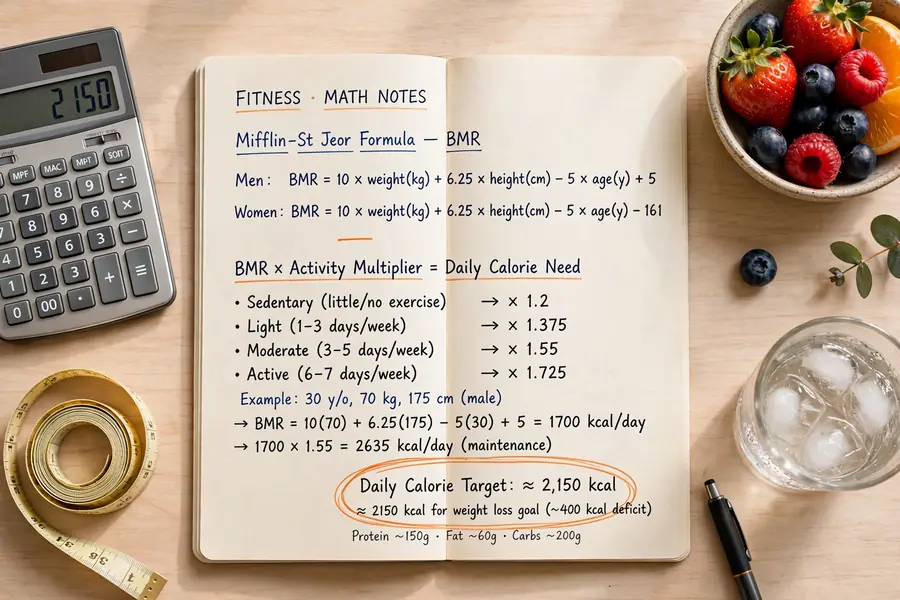
First, estimate your basal metabolic rate (BMR) — what your body burns at complete rest — with the Mifflin-St Jeor equation. It is the resting equation most recommended today: in the original 1990 study, Mifflin and colleagues measured resting burn by indirect calorimetry in 498 adults and found the older 1919 Harris-Benedict equations overestimated it by about 5%.
Men: BMR = (10 × weight in kg) + (6.25 × height in cm) − (5 × age) + 5
Women: BMR = (10 × weight in kg) + (6.25 × height in cm) − (5 × age) − 161
Then multiply by an activity factor to get your TDEE:
| Multiplier | Level | What it actually looks like |
|---|---|---|
| 1.2 | Sedentary | Desk job, driving commute, under ~5,000 steps a day, no planned exercise |
| 1.375 | Lightly active | Desk job plus 1–3 workouts a week, or 5,000–7,500 steps a day |
| 1.55 | Moderately active | Training 3–5 times a week with an active day, roughly 7,500–10,000 steps |
| 1.725 | Very active | Physical job plus regular training, or 10,000–12,500 steps a day |
| 1.9 | Athlete level | Manual labour combined with training, or twice-daily sessions |
Grade your normal week, not your best one. This is where most people go wrong: a desk worker who trains three times a week is usually “lightly active,” not “moderately active” — three gym hours barely move a 168-hour week. When torn between two levels, pick the lower one. You can always adjust up; starting too high burns weeks wondering why nothing is happening.
If you’d rather skip the hand math, our TDEE calculator runs the same two steps automatically and shows your maintenance number instantly.
Step 2: Choose Your Deficit Size (and Subtract It)
A calorie deficit is simply your TDEE minus your daily intake. The question is how big to make the gap. Public-health guidance gives a clear, verified frame: the CDC’s weight-loss guidance says that to lose about 1 to 2 pounds per week, you reduce intake by 500–1,000 calories per day.
A quick correction worth making, because it is everywhere online: you will often read that “the CDC says 500–750.” That claim is false — the CDC’s actual published range is 500–1,000 calories per day. The narrower version appears to be a misquote that kept getting repeated. Use the real range.
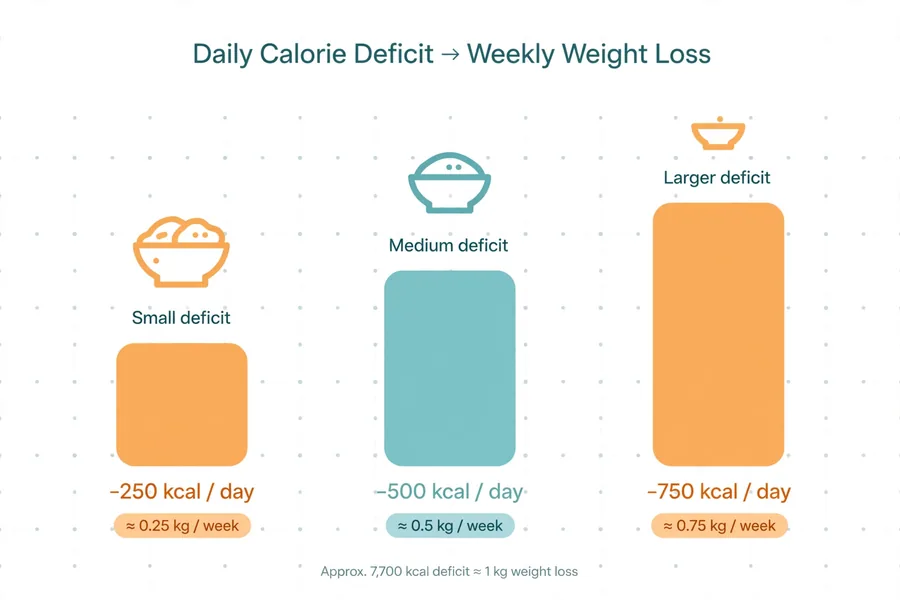
Here is what each deficit size predicts per week, using the long-standing figure of roughly 3,500 calories per pound of body fat (about 7,700 kcal per kg):
| Daily deficit | Expected loss per week | Best for |
|---|---|---|
| 250 kcal | ~0.5 lb (~0.25 kg) | Smaller bodies, last stretch of weight loss, people who hate restriction |
| 500 kcal | ~1 lb (~0.45 kg) | Most adults — the sweet spot of visible progress and sustainability |
| 750 kcal | ~1.5 lb (~0.7 kg) | Larger starting weights, shorter pushes |
| 1,000 kcal | ~2 lb (~0.9 kg) | The top of the CDC’s range; keep it short-term and check your floor |
A percentage-based framing works just as well and scales with body size: most dietitians land people at 10–20% below maintenance. For a 2,000-calorie TDEE that’s 200–400 kcal; for a 2,800-calorie TDEE it’s 280–560 kcal. Smaller bodies have smaller margins, so the fixed 500 number suits them less than it suits larger ones.
One caveat the table can’t show: the 3,500-per-pound rule is a planning estimate, not a promise. Real bodies adapt — energy needs fall as you get lighter, and unconscious daily movement (NEAT) tends to drop. Your first weeks track the table closely; later weeks often run a little slower. That’s normal, not a sign the math was wrong.
There is also a floor. The CDC’s Diabetes Prevention Program materials use the same 500–1,000 kcal/day subtraction and set a hard lower boundary: never go below 1,200 calories per day. Below that, getting enough protein, iron, calcium, and fiber from food alone becomes mathematically difficult — which is exactly why the subtraction must come from your TDEE, never from your BMR.
Step 3: Calculate My Calorie Deficit — A Full Worked Example
If you want to calculate my calorie deficit with a pen instead of a calculator, the method below needs only four numbers: your age, sex, height, and weight. Let’s run it end to end for a real case.
Meet Daniel. He’s 42, weighs 92 kg, is 178 cm tall, works a desk job, walks on his lunch break, and plays football once a week. His week honestly fits “lightly active.”
Step 1 — his BMR.
(10 × 92) + (6.25 × 178) − (5 × 42) + 5 = 920 + 1,112.5 − 210 + 5 = 1,827.5 ≈ 1,828 kcal/day at rest.
Step 2 — his TDEE.
1,828 × 1.375 = 2,513.5 ≈ 2,514 kcal/day. That’s his maintenance level — eat near it and his weight holds.
Step 3 — his deficit.
He wants a steady 1 lb a week, so he subtracts 500: 2,514 − 500 = 2,000 kcal/day. That’s his daily target.
Notice how comfortable the answer is: no crash diet, no four-digit shock — just a target he can build real meals around. At that pace he’d lose roughly 4 lb a month.
A second, quicker example shows how the same method scales down. Priya is 35, weighs 72 kg, is 168 cm tall, and is sedentary. Her BMR: (10 × 72) + (6.25 × 168) − (5 × 35) − 161 = 720 + 1,050 − 175 − 161 = 1,434. Her TDEE: 1,434 × 1.2 = 1,721. With a gentler 300-calorie deficit (smaller body, smaller margins): 1,721 − 300 = 1,421 ≈ 1,420 kcal/day — about 0.6 lb a week, sustainable without misery.
Should I subtract the deficit from my BMR or my TDEE?
Always subtract from your TDEE. BMR covers only the 60–70% of your day spent at rest — it is not what you actually burn. Eating 500 calories below your BMR would put most adults far under a livable intake. TDEE minus deficit gives your real daily target; BMR minus deficit does not.
This is the single most common hand-calculation mistake on weight-loss forums. Your BMR is a building block, not your starting line. Daniel’s BMR is 1,828 and his target is 2,000 — below his maintenance of 2,514, but above his resting burn, exactly as it should be.
How can I work out my deficit without a calculator?
Convert weight to kg and height to cm, then run the Mifflin-St Jeor equation for your BMR: men (10 × kg) + (6.25 × cm) − (5 × age) + 5; women the same with − 161. Multiply by your activity level (1.2–1.9), then subtract 500–1,000 calories. The result is your daily target.
That’s genuinely the whole recipe. The worksheet above is just this paragraph with numbers in it — once you’ve done it once, you can redo it in two minutes whenever your weight changes.
Is a 500-calorie deficit enough to lose weight?
Yes — for most adults it is the sweet spot. A daily 500-calorie deficit predicts about 1 pound (0.45 kg) of loss per week, squarely inside the CDC’s gradual-loss guidance. It is large enough that progress shows within two weeks, but small enough that meals still look like meals and adherence survives.
If 500 feels like too much food is being cut, drop to 300–400. The deficit you can hold for six months beats the perfect one you abandon in three weeks, every time.
Why do different calculators give me different deficit numbers?
They nearly always agree on the first half: every mainstream tool computes BMR with Mifflin-St Jeor, so results land within about 5%. They disagree on the activity multiplier, where one band is worth 250–300 calories a day — an entire deficit’s worth. Pick the lower band when torn; your two-week weight trend settles the rest.
Some sites also define the bands differently — one site’s “lightly active” is another’s “moderately active” — so comparing raw numbers across tools is apples to oranges. Compare the method, not the output.
Check Your Number: The Two-Week Test
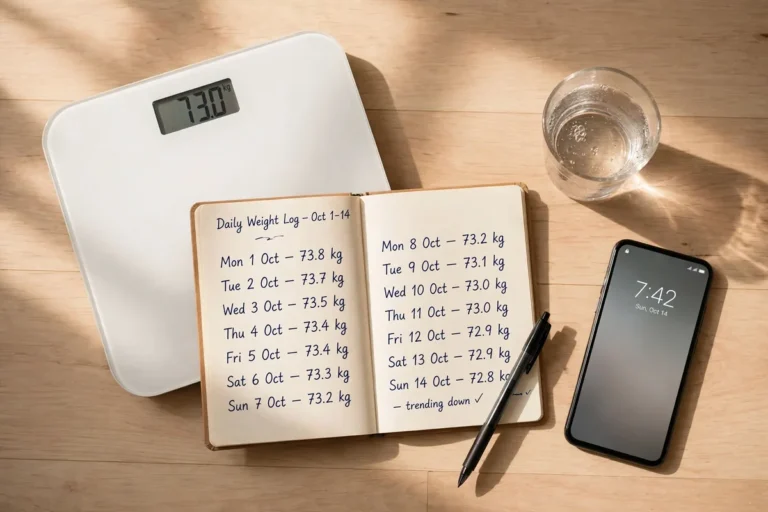
Your calculated target is a first draft, not a verdict. Verify it the way researchers do: eat near the target for two to three weeks, weigh yourself under the same conditions, and judge the weekly average — never single days, which water and salt can swing by a kilo.
If the average is dropping near your predicted rate, the number is right. If it’s flat after two to three weeks, adjust down by 100–200 calories and test again. If it’s falling much faster than planned, eat a little more — losing too fast costs muscle you want to keep.
When you calculate my calorie deficit again after a few months, don’t be surprised if the target is lower. A lighter body costs less to run, so recalculate after roughly every 5 kg of change or whenever a stall lasts three weeks despite honest tracking. And if you want the full picture of what the deficit does in the body once it’s set, our guide to what a calorie deficit is and how it works covers the concept side of the story.

For the method itself, one more piece of official backing: the CDC’s own weight-loss guidance frames healthy loss as gradual and steady — about 1 to 2 pounds a week — which is exactly the pace the 500–1,000 kcal/day range produces.
Frequently Asked Questions
How many calories should I eat to lose weight?
Your TDEE minus your chosen deficit — that is your personal number, and it beats any generic figure. For context, most adults land between 1,400 and 2,000 calories a day. Avoid going below 1,200 (women) or 1,500 (men) without professional guidance.
Why am I not losing weight in a calorie deficit?
The three usual reasons: under-recorded intake (cooking oil, drinks, and tastes while cooking are the classic misses), an overestimated activity level in the original calculation, and water-weight fluctuation hiding real fat loss. Recheck the activity choice honestly, weigh under the same conditions, and compare weekly averages before changing anything.
Should I recalculate my deficit as I lose weight?
Yes. Your TDEE falls as you get lighter, so a target that worked at 95 kg overshoots at 88 kg. Redo the three steps every 4–6 weeks or after roughly every 5 kg of change. A stall lasting three weeks despite consistent tracking is the practical signal.
Can I build muscle in a calorie deficit?
Beginners and people returning after a break often can, at least for a while. Prioritise protein (roughly 1.6 g per kg of body weight is the commonly cited research target) and resistance training two to three times a week — that’s what preserves, and sometimes builds, lean mass while fat comes off.
Do I need to count calories forever?
No. Most people track for a few weeks to learn what their usual portions actually contain, then shift to a lighter approach: consistent meals, a protein target, and a weekly weigh-in. Revisit the calculator only when your weight or activity changes noticeably.
Disclaimer
This calculator and the information on this page are for general education and are not medical advice. Results are estimates. Talk to a doctor or registered dietitian before you change your diet, especially if you have a medical condition, take medication, are pregnant or breastfeeding, or have a history of disordered eating.





2 Comments