
What Should My Calorie Deficit Be? Mild, Moderate & Aggressive Tiers
Written by Elise Ava · Last reviewed 23 October 2026
If you’re asking what should my calorie deficit be, here’s the honest answer: the right calorie deficit size is the mildest one that still moves the scale — because that’s the one you’ll still be following in three months. Most people do best starting at a moderate deficit of about 500 kcal a day, roughly 20% of what they burn. The table below shows all three tiers — mild, moderate, aggressive — with the weekly-loss math for each, so you can size yours deliberately instead of guessing.
This page owns one question only: how BIG should the deficit be. It assumes you already know what a deficit is (that’s our pillar guide on how a calorie deficit works) and that you can already compute your maintenance number — if not, our step-by-step guide to calculating your calorie deficit covers the arithmetic.
If you haven’t found your daily target yet, see how many calories to lose weight — then read how to be in a calorie deficit to put your tier into practice.
[kg_to_stone_pounds_converter]
The Three Deficit Tiers, Compared
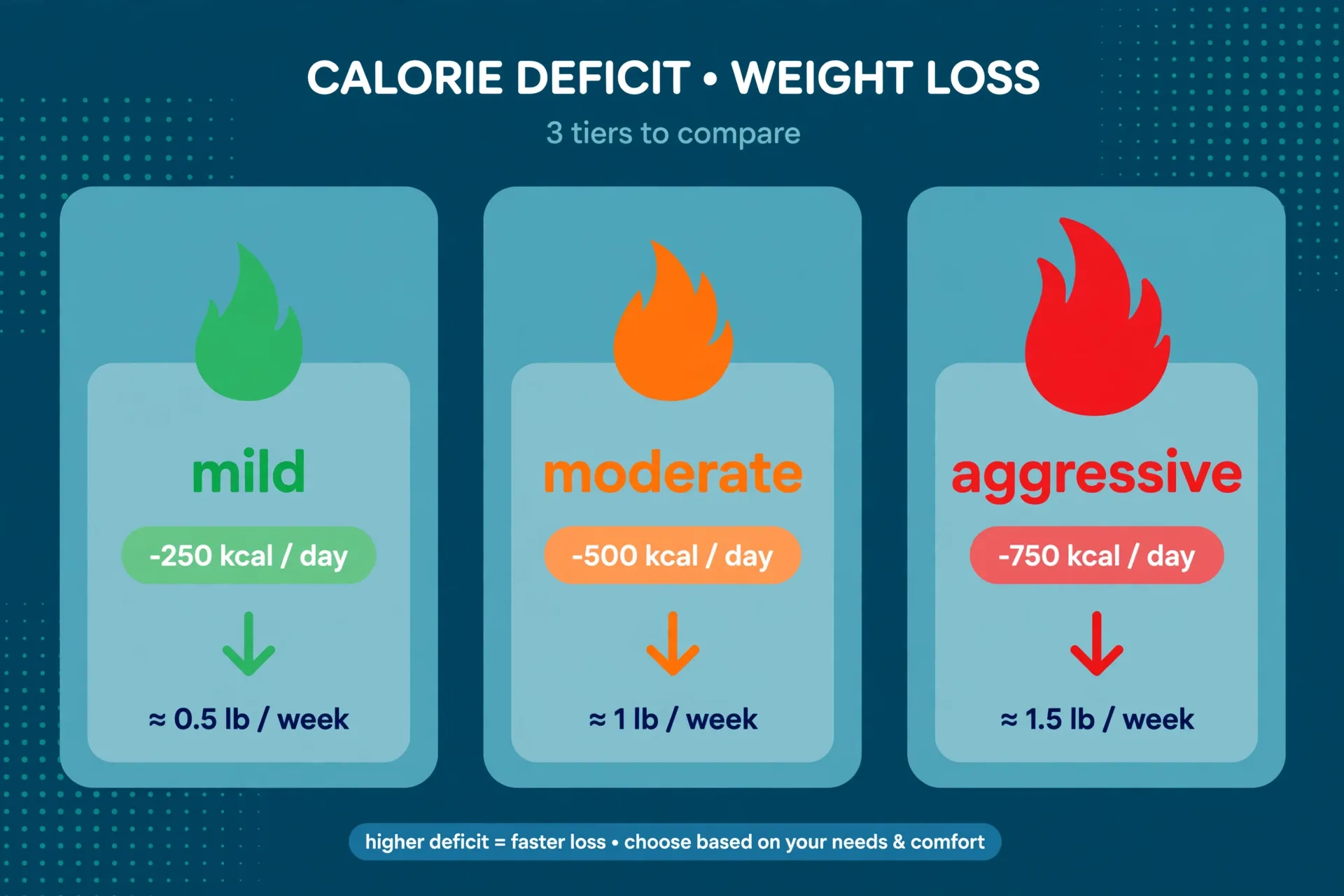
Every defensible deficit you’ll ever see falls into one of three tiers. The numbers below are my synthesis of the clinical guidelines — the NHLBI’s 1998 guidance pairs a 500–1,000 kcal/day deficit with 1–2 lb of weekly loss, the 2013 AHA/ACC/TOS guideline prescribes a 500 or 750 kcal/day deficit for adults with obesity, and the CDC still frames healthy loss at a gradual 1–2 lb a week — combined with the percentage-based convention coaches actually use.
The weekly-loss column uses the plain 7,700 kcal-per-kilo rule: one kilo of body fat stores roughly 7,700 kcal (that’s the metric twin of the old 3,500-kcal-per-pound rule), so weekly loss ≈ daily deficit × 7 ÷ 7,700.
| Tier | Daily deficit | Deficit as % of TDEE | Expected weekly loss* | Best for |
|---|---|---|---|---|
| Mild | 250–350 kcal | 10–15% | 0.2–0.3 kg (0.5–0.7 lb) | Close to goal weight · muscle retention · long diet phases |
| Moderate | 400–600 kcal | 15–25% | 0.35–0.55 kg (0.45–1.2 lb) | Most people · the default starting point |
| Aggressive | 650–1,000 kcal | 25–30% | 0.6–0.9 kg (1.3–2 lb) | Significant weight to lose · short, focused pushes |
*Expected loss, not guaranteed: the 7,700-kcal rule is a planning estimate. Real loss runs a little slower as the body adapts — week one also runs high because of water.
Notice what the table does for you. Pick the column you care about — speed, comfort, or how your body actually looks at the end — and the deficit size picks itself. A 300 kcal deficit and a 750 kcal deficit aren’t just “slower” and “faster”; they’re different experiences with different trade-offs. The mild tier barely disturbs your life. The aggressive tier disturbs everything, including your sleep and your training, which is why it needs a plan rather than just willpower.
Why a Calorie Deficit Percentage Beats Flat Numbers
Here’s the confusion that wrecks most DIY diets: a flat number means nothing until you know what it’s relative to. A 500-calorie deficit on a 3,200-calorie TDEE is a gentle 16% cut. The same 500 calories on a 1,700-calorie TDEE is a brutal 29% cut — nearly a third of everything the person eats.
Switching from flat calories to a calorie deficit percentage solves the relativity problem completely. The percentage is your deficit divided by your TDEE, and it travels with you: a 150 cm sedentary woman and a 190 cm construction worker can both run “moderate” at 20%, even though their calorie numbers look nothing alike. It’s also the language the guidelines quietly use — alongside its flat numbers, the AHA/ACC/TOS guideline prescribes a 30% energy deficit as one of its accepted methods.
Once you know your TDEE, pick your calorie deficit percentage from the tier table and multiply. A 2,400 TDEE at a moderate 20% is a 480 kcal deficit and a 1,920 target. Same answer the flat table would give most people, but now it’s scaled to you — and when your TDEE drops as you lose weight, you re-apply the same percentage instead of clinging to an old number.

Is a 1,000 Calorie Deficit Too Much?
Is a 1,000 calorie deficit too much?
For most people, yes. A 1,000-calorie deficit sits at the very top of the clinical range — the NHLBI pairs 500–1,000 kcal/day with 1–2 lb of weekly loss, but at the upper end you’ll likely land near the minimum intake floor, feel constantly hungry, and lose muscle alongside fat. It only suits people with a high TDEE, ideally under supervision.
This is the single most asked question on every weight-loss forum, and the answer is always “it depends on your TDEE” — which is why percentage sizing exists. A 100 kg active man with a 3,000 TDEE running a 1,000 kcal deficit still eats 2,000 calories: that’s aggressive (33%, just past the top tier) but survivable. A 60 kg sedentary woman with a 1,700 TDEE on the same deficit eats 700 calories: that’s starvation, full stop.
The CDC’s guidance on steady weight loss keeps pointing at the same lesson: people who lose gradually are more likely to keep it off. A 1,000 kcal deficit also pushes past the useful ceiling researchers cite — about 1% of body weight per week — beyond which extra speed comes increasingly from muscle and water, not fat. If you want the fastest safe tier, cap yourself at 30% of TDEE, the level the clinical guideline names, and keep protein high.
One Person, Three Tiers: A Worked Example
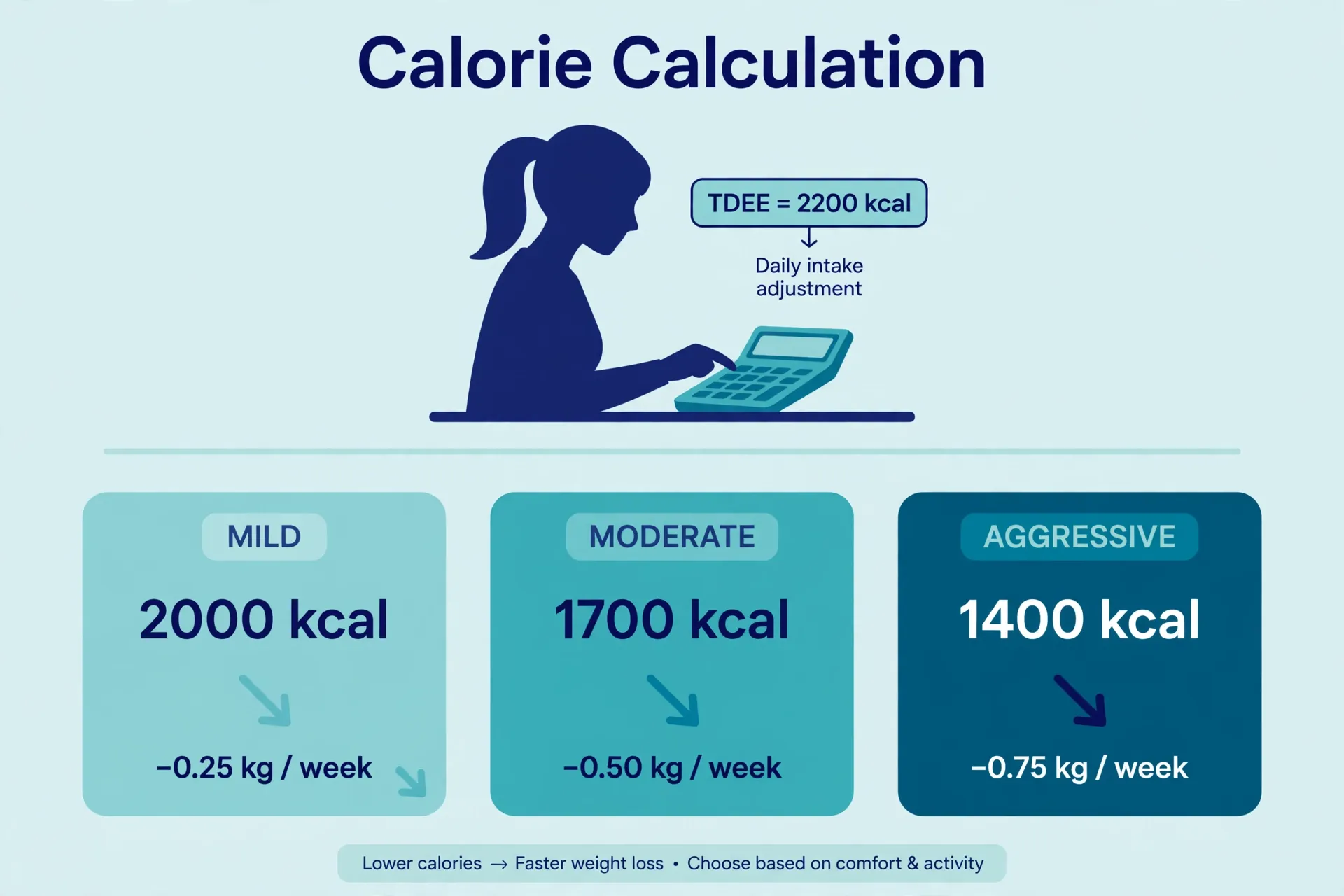
Meet a realistic dieter: 40 years old, 92 kg, lightly active, TDEE 2,200 kcal/day. Here’s what each tier actually looks like for her — same woman, same maintenance, three different diets.
Mild — 15% of TDEE. 0.15 × 2,200 = 330 kcal/day deficit. Target: 1,870 kcal/day. Weekly: 330 × 7 = 2,310 kcal ÷ 7,700 = 0.30 kg/week (~0.66 lb). She’ll barely notice she’s dieting. At this pace she loses about 7–8 kg in six months — slow, and the easiest of the three to sustain.
Moderate — 22% of TDEE. 0.22 × 2,200 = 484, rounded to 480 kcal/day deficit. Target: 1,720 kcal/day. Weekly: 480 × 7 = 3,360 kcal ÷ 7,700 = 0.44 kg/week (~0.96 lb). Mild hunger before meals, normal training, visible monthly change. This is the tier most guidelines are describing when they say “500 kcal/day.”
Aggressive — 29% of TDEE. 0.29 × 2,200 = 638, rounded to 640 kcal/day deficit. Target: 1,560 kcal/day. Weekly: 640 × 7 = 4,480 kcal ÷ 7,700 = 0.58 kg/week (~1.28 lb). Real hunger, some training fatigue, and every social dinner becomes a negotiation. Notice it’s still under the 1%-of-bodyweight ceiling (0.92 kg/week for her) — aggressive isn’t reckless by itself, but it has a shelf life of weeks, not months.
Same math, same woman — and the three targets differ by just 310 calories a day. That’s the value of sizing in tiers instead of copying someone’s number from a forum.
Is a 300-Calorie Deficit Enough to Lose Weight?
Is a 300-calorie deficit enough to lose weight?
Yes — it’s the mild tier. A 300-calorie daily deficit runs 2,100 kcal a week, which converts to roughly 0.27 kg (about half a pound) a week at 7,700 kcal per kilo. That’s 7 kg across six months if you stay consistent — best when you’re fairly lean, hate feeling restricted, or want to keep every ounce of strength.
People dismiss the mild tier because the weekly number looks unimpressive. Flip it around: a 300 kcal deficit is one skipped pastry and a walked commute. Adherence at 90% of a mild plan beats adherence at 50% of an aggressive one — and the math agrees, since half an aggressive deficit is usually worse than a full mild one.
There’s also a muscle argument. Smaller deficits leave more of your loss coming from fat and less from lean tissue, especially combined with protein and lifting. If your goal is to look different at the end rather than just weigh less, mild is arguably the tier that gets you there.
Which Tier Should You Actually Pick?
Start moderate unless you have a specific reason not to. The moderate tier — 400–600 kcal, 15–25% of TDEE — is where every major guideline converges (the 2013 AHA/ACC/TOS obesity management guideline literally prescribes 500 or 750 kcal/day), and it’s the best balance of visible progress and livable days.
Go mild if: you’re within 5–7 kg of your goal, you’re dieting while trying to keep strength, you’ve dieted hard before and burned out, or you simply want the path of least resistance. Mild is also the right tier for long phases — anything past 12 weeks.
Go aggressive if: you have a lot to lose (the same percentage deficit is easier to tolerate at higher body weights), you’re time-boxing a short push of 4–8 weeks, and your intake still lands comfortably above minimum levels. Keep protein high — around 1.6 g per kilo of body weight is the commonly cited target for dieting lifters — and treat the aggressive tier as a sprint with a planned exit, not a lifestyle.
One thing to watch in any tier: your percentage is only as good as your TDEE estimate. If the scale hasn’t moved for three honest weeks, the problem is usually the TDEE number, not the tier — recalculate before you cut deeper.
When Should I Adjust My Deficit?
When should I adjust my deficit?
Adjust when the scale tells you to — roughly every 4–6 weeks or after every 4–5 kg lost. As you get lighter, your TDEE falls, so a deficit that once worked quietly stops producing. Recalculate your maintenance, re-apply your tier, and keep going. Also adjust sooner if weight hasn’t moved for 2–3 weeks despite honest tracking.
This is the adjustment loop that separates people who lose weight once from people who lose it and keep it: same tier percentage, new TDEE, new target. A woman who started at 2,200 TDEE on a moderate 22% (target 1,720) and drops to a 2,000 TDEE re-applies 22% for a new target of 1,560 — she doesn’t stay at 1,720 and wonder why month three stalled.
Adjust upward too, not just down. If life gets stressful, sleep collapses, or training stalls badly, stepping a tier down for a few weeks protects the long game. The deficit serves the goal; when it stops serving, change it.
One Line on Minimum Intakes
Sizing your deficit is only half the job — the other half is the floor it lands on. A perfectly sized 25% deficit means nothing if it puts your intake somewhere unsustainable. We keep the full floor-and-safety topic on its own page (/minimum-calories-per-day/, coming in the schedule) because it deserves the space; the one rule for this page: never let any tier push your target into a range you couldn’t eat for months.
Frequently Asked Questions
What is the best calorie deficit for beginners?
Start moderate: about 400–500 kcal a day, or 15–20% of your TDEE. It’s fast enough to see the scale move within two weeks, gentle enough to learn tracking and meal structure without willpower, and it’s the tier with the most guideline backing.
How many calories should I eat to lose 1 pound a week?
Subtract 500 kcal from your TDEE — a 3,500 kcal weekly deficit maps to roughly 1 lb under the standard rule. If your TDEE is 2,200, that means eating 1,700. For small or sedentary people, check that 500 kcal isn’t more than 30% of your TDEE before committing to it.
Can a calorie deficit be too small?
Yes — below about 10% of TDEE (under ~200 kcal for most people), normal tracking error and daily weight swings drown out the signal. You’ll technically be losing, but you won’t be able to tell, which kills motivation. The mild tier (250–350 kcal) is about the smallest deficit that’s still measurable week to week.
How long should I stay in a calorie deficit?
Until you reach your goal or need a break — whichever comes first. Practical caps: 12–16 weeks on moderate, 4–8 weeks on aggressive, then 2–4 weeks at maintenance before another push. Long unbroken deficits raise the odds of burnout and plateaus.
Do I need to recalculate my deficit as I lose weight?
Yes. A smaller body burns fewer calories, so your TDEE shrinks as you lose — typically noticeably after every 4–5 kg. Recalculate TDEE every month or two and re-apply your chosen tier percentage to get your new target.
Is it better to cut calories or exercise more?
For sizing your deficit, diet does the heavy lifting — it’s far easier to not eat 500 kcal than to burn 500 kcal moving. Exercise still matters enormously for keeping muscle, mood, and metabolic rate during the cut, but count on food for the deficit and movement for everything else.
Disclaimer
This calculator and the information on this page are for general education and are not medical advice. Results are estimates. Talk to a doctor or registered dietitian before you change your diet, especially if you have a medical condition, take medication, are pregnant or breastfeeding, or have a history of disordered eating.
Reviewed by: Calorie deficit calculator team October 2026
Source: Conversion of calorie deficit to weight loss based on energy balance and the guideline value of approximately 7700 kcal per kg of body fat
Published: October 2026
Status: January 2026
Data protection: All entries are processed exclusively in your browser and are not transferred to us or third parties.




3 Comments