
How to Be in a Calorie Deficit: The Practical Guide That Actually Works
Written by Elise Ava · Last reviewed 23 October 2026
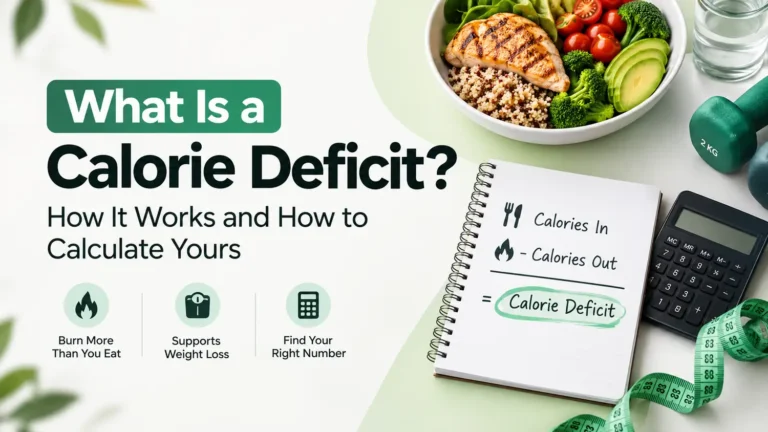
Learning how to be in a calorie deficit is simpler than diet culture makes it look: you eat and move so your body uses slightly more energy than it takes in, day after day, for weeks. A deficit of about 500 calories a day is the classic starting point — enough to lose roughly a pound a week without feeling like you’re starving.
This is the practical sequel — how to stay in a calorie deficit day to day. If you’ve already read what a calorie deficit actually is, you’ll recognize the idea; this page is the habits, the food, and the checks. No math drills — those live on our calculation guide.
What Being in a Deficit Looks Like on a Normal Day
Forget the image of tiny salads and misery. A person in a working deficit eats three real meals, has a snack or two, goes out with friends sometimes, and still loses weight — because the small changes add up invisibly.
Here’s what their day actually contains: protein at every meal, vegetables taking up real space on the plate, one clear rule about sugary drinks, and a walk they actually enjoy. That’s most of it. The deficit isn’t an event — it’s the background hum of a normal-ish day.
The single biggest mental shift is this: you’re not “on a diet,” you’re running a slightly smaller energy budget. Diets end. Budgets just continue.
Haven’t found your number yet? Start with our guide on how many calories to lose weight.

Can I Be in a Calorie Deficit Without Counting Calories?
Can I be in a calorie deficit without counting calories?
Yes — counting calories is a tool, not a requirement. A deficit only needs one thing to be true: you consistently eat less energy than you use. You can get there with structure instead of arithmetic: protein at every meal, vegetables on half the plate, and one rule about liquid calories. Weighing teaches you faster, but it’s optional.
That said, there’s a catch beginners keep tripping over. Eyeballing portions works once you know what portions look like — and most people learn that by measuring for a week or two first. Think of counting as training wheels: useful at the start, removable later.
The no-counting playbook that actually holds up:
- Build every meal on the plate method: half vegetables, a quarter lean protein, a quarter whole grains or starchy veg.
- Eat protein first at meals — it slows you down and blunts the rest of the plate.
- Kill liquid calories first. One sugary coffee or soda a day is 150–300 calories doing nothing for your hunger.
- Set one non-negotiable daily habit: a walk, a step target, or a vegetable quota. Structure beats willpower.
The Two Levers: Eat Less, Move More
Every calorie deficit on earth is pulled by exactly two levers: eat a bit less, or move a bit more. Most people should pull both, but knowing what each lever does keeps you from leaning on the wrong one.
| Lever | What it changes | Realistic daily contribution | Best for |
|---|---|---|---|
| Eat less | The “calories in” side | 300–500 kcal, via portion and swap changes | Everyone — it’s where most of the deficit comes from |
| Move more (exercise) | The “calories out” side | 150–300 kcal, e.g. 30–45 min brisk walking | Preserving muscle, mood, sleep, and keeping weight off |
| Both together | Both sides | 450–700 kcal combined | The combination guidelines recommend |
The diet lever does the heavy lifting on the number — it’s far easier to skip 400 calories of snacks than to burn 400 calories on a treadmill. The movement lever does the heavy lifting on everything else: muscle, energy, and whether the weight stays off.
One honest warning: exercise makes some people hungrier, and a “reward” meal after a workout can wipe out the burn twice over. If your appetite spikes after training, anchor that day with extra protein rather than extra snacks.
How to Eat at a Deficit Without Starving
The difference between a deficit you quit in week two and one you barely notice is satiety — how full food keeps you per calorie. Two meals can carry identical calories and feel completely different three hours later.
Three things drive satiety, and the research on each is solid:
Protein comes first. It keeps you fuller than carbs or fat and costs more energy to digest. The International Society of Sports Nutrition’s position stand (Jäger et al., 2017) puts exercising individuals at 1.4–2.0 g of protein per kg of body weight per day — and notes that resistance-trained people in a deficit may need more to hold onto muscle. For a 78 kg person, that’s roughly 110–155 g a day: a palm-sized protein portion at each meal gets you most of the way there.
Fiber fills the gaps. The 2020–2025 Dietary Guidelines put adequate fiber at about 14 g per 1,000 calories — so around 25–30 g a day for most dieters. Beans, lentils, oats, vegetables, and fruit do the work. Fiber slows digestion and feeds the gut bacteria that help regulate appetite.
Volume beats density. This is the CDC’s own advice: people feel full from the amount of food they eat, not the calories in it. Their classic example takes a cup of mac and cheese from about 540 calories down to 315 — same serving size — by swapping whole milk for non-fat, cutting the cheese, and bulking it out with spinach and tomatoes. Same plate, 225 fewer calories.
What Should I Eat in a Calorie Deficit?
What should I eat in a calorie deficit?
Eat food that fills you up for the fewest calories: lean protein, vegetables, fruit, legumes, whole grains, and broth-based soups. The research-backed formula is protein at every meal, fiber from plants, and volume — foods with lots of water weigh you down less per bite. Nothing is banned; the deficit comes from the total, not single foods.
The 2020–2025 Dietary Guidelines’ healthy eating pattern — the official framework behind this advice — also sets the guardrails: keep added sugars and saturated fat each under 10% of daily calories, and sodium under 2,300 mg a day. Those limits are exactly where most people’s “mystery calories” hide.
The Swap Table: Same Calories, Way More Food
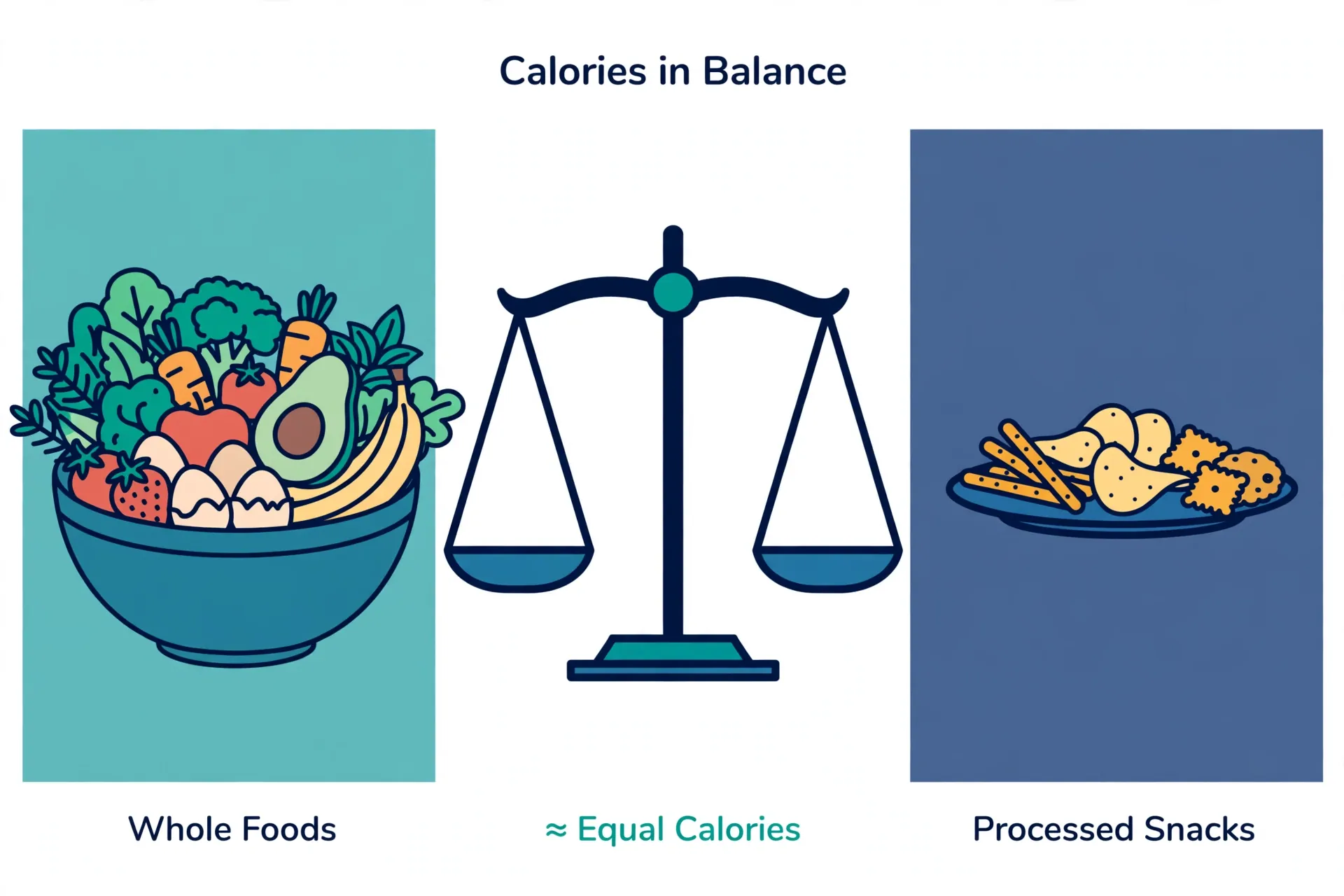
Swaps are the lowest-effort lever in the whole deficit game. You don’t eat less food — you eat smarter food.
| Instead of this (~calories) | Try this (~calories) | What changes |
|---|---|---|
| Tortilla chips, 40 g (~200) | Air-popped popcorn, 100 g (~200) | A small handful becomes a big bowl |
| Flavoured latte with syrup (~250) | Black coffee or latte with skim milk (~50) | ~200 cal saved, same ritual |
| Small chocolate bar, 45 g (~250) | Greek yogurt 200 g + berries 100 g (~200) | Triple the volume, 25 g protein |
| 1 tbsp olive oil drizzled freely (~120) | Measured 1 tsp olive oil (~40) + lemon/herbs | Same flavour, 80 cal saved |
| Cheese-heavy pasta bake, 1 cup (~540) | Veg-bulked pasta, 1 cup (~350) | The CDC mac-and-cheese trick in action |
| Sugary cereal, 60 g (~240) | Oats 50 g + banana (~280) | Slightly more calories, hours more fullness |
Notice the pattern: nothing on the right side is sad diet food. The swap table works because it keeps the experience — the bowl, the coffee, the pasta — and only changes the energy density.
How Exercise Fits In
Do I Need to Exercise to Be in a Calorie Deficit?
Do I need to exercise to be in a calorie deficit?
No. Diet alone can create the full deficit — fat loss is driven by energy balance, not by the gym. But exercise earns its place: the American College of Sports Medicine recommends building toward at least 150 minutes a week of moderate activity, because it preserves muscle, protects mood and sleep, and makes keeping the weight off more likely.
That 150-minute figure is the minimum effective dose, not the dream target. ACSM’s position stand is blunt about the numbers: under 150 minutes a week, weight loss from activity alone is minimal; above it, losses are modest but real — and 200–300 minutes a week is where long-term maintenance lives.
For a dieter, exercise has a job description beyond burning calories:
- Strength training protects the good weight. In a deficit, your body wants to burn muscle along with fat. Two to three weekly sessions of resistance work tell it to keep the muscle.
- Walking protects the deficit itself. A daily walk burns 150–250 calories, costs nothing, and barely triggers hunger — unlike intense cardio, which can.
- Activity guards your sleep and mood, both of which quietly control next-day appetite. Short sleep raises ghrelin (the hunger hormone) and lowers leptin (the fullness one).
You don’t need a program to start. Walk after one meal a day, add two bodyweight sessions a week, and you’ve covered the essentials.
Building a Sustainable Calorie Deficit
Here’s the part most guides skip: the best deficit isn’t the biggest one — it’s the one you’ll still be running in three months. A sustainable calorie deficit is one you could repeat for months without dreading your meals — that’s the whole test.
Sustainability has a checklist, and the NIDDK spells most of it out in its guide to choosing a safe weight-loss program:
- Realistic goals. Their experts recommend an initial target of 5–10% of your starting weight within six months — for a 200 lb person, that’s about 10 lb. Slow targets survive; heroic ones don’t.
- A plan you can keep. The best eating plan is the one backed by evidence that fits your life, culture, and tastes — “so you can stick with it over the long term,” in their words.
- Movement built in. Working toward 150+ minutes of weekly activity, plus 150–300 for keeping weight off afterward.
- Weekly check-ins. Weigh yourself weekly, track habits daily, and treat stalls as data, not failure.
And the warning signs that a plan is not sustainable: promises like “lose 30 pounds in 30 days,” bans on entire food groups, and anything that makes normal social life impossible. NIDDK lists exactly these as reasons to walk away. A deficit that costs you your life isn’t a plan — it’s a countdown to quitting.
How big should your own deficit be? That’s a separate question with its own answer — mild, moderate, and aggressive deficits suit different people — and it has a dedicated guide. Pick your size there; run it here.
A Real Day in a Deficit: The Numbers
Theory is nice; here’s what it looks like on a plate. Meet the numbers for a realistic person — call her Maya, 32, 78 kg (172 lb), 165 cm, desk job plus evening walks.
Her estimated daily burn (TDEE) is about 2,350 calories. With a 500-calorie deficit, her target lands at 1,850 a day. (How that 2,350 is estimated step by step is covered in how to calculate your calorie deficit — this page is about living inside the number.)
| Meal | What she eats | Calories | Protein |
|---|---|---|---|
| Breakfast | 200 g Greek yogurt + 40 g oats + 100 g blueberries | 350 | 25 g |
| Lunch | 150 g grilled chicken + 200 g cooked rice + big mixed-vegetable salad + 1 tsp olive oil | 615 | 51 g |
| Snack | 1 apple + 15 g almonds | 185 | 4 g |
| Dinner | 140 g salmon + 200 g boiled potatoes + 200 g broccoli | 513 | 38 g |
| Evening | 20 g dark chocolate | 110 | 1 g |
| Total | ~1,773 | ~119 g |
The day lands at about 1,773 — roughly a 575-calorie deficit against her 2,350 burn, and she stayed under her 1,850 target with room for a splash of milk in her tea. Protein hits ~119 g, or about 1.5 g per kg of her weight — squarely in the ISSN’s 1.4–2.0 g/kg range for active dieters.
Two things worth noticing. First, nothing on that menu is a “diet food” — it’s ordinary food in ordinary amounts, just assembled with intent. Second, the deficit came mostly from structure (measured oil, no sugary drinks, protein-first meals), not from skipping anything. This is what the two levers look like in practice.
How to Track and Verify You’re Actually in One
This is where deficits live or die — and it’s the exact confusion behind the internet’s most-posted complaint: “I think I’m in a deficit but I’m not losing weight.” The forums are full of it, and the answer is almost always one of three things: the deficit was never real (tracking gaps), water is hiding the fat loss (scale noise), or the target was built on a wrong activity level.
How Do I Know If I’m Actually in a Calorie Deficit?
How do I know if I’m actually in a calorie deficit?
The trend tells you, not any single weigh-in. If your average weight is falling over 3–4 weeks of honest tracking, you’re in one. If the 4-week trend is flat, your deficit isn’t real yet — usually because of tracking gaps (oils, drinks, bites), weekend calories you forgot, or an overestimated activity level. Tighten tracking for one week, not your intake.
A verification routine that takes five minutes a day:
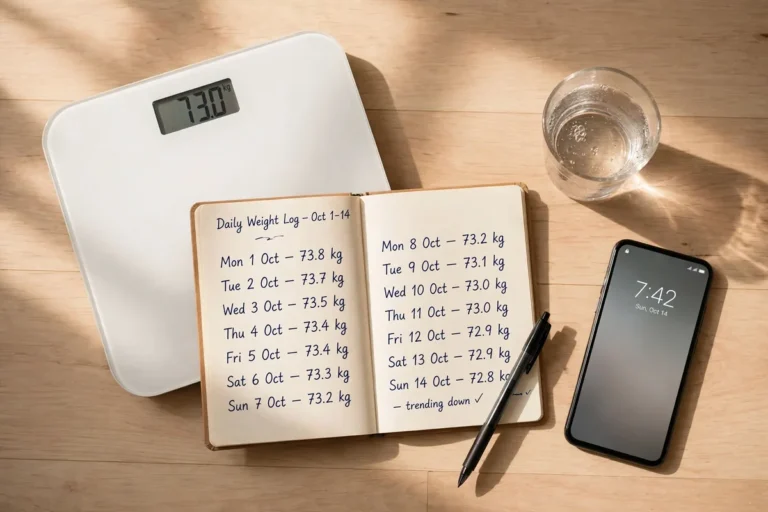
- Weigh daily, judge weekly. Same time, same conditions, morning after the bathroom. Write it down. Your weight swings 1–3 lb day to day from water, sodium, glycogen, and digestion — that’s noise, not fat.
- Track food honestly for two weeks. Use a food scale for calorie-dense items (oils, nut butters, cheese, meat) — eyeballing a “tablespoon” of peanut butter is the most common 200-calorie error in existence. Log bites, drinks, and cooking oil.
- Audit your weekends. Weekday-perfect plus untracked weekends is the classic fake deficit. If you eat out twice a week, pre-log the meals.
- Compare the 4-week trend to your target. Losing roughly in line with your deficit? Keep going. Flat for a full month with honest tracking? Your burn estimate was high — drop intake by 100–200 or add steps, then watch another two weeks.
Photos and a tape measure at the waist every two weeks are worth adding. When the scale stalls but the waist shrinks, fat loss is still happening — water is just sitting in the way.
Can I Eat in a Calorie Deficit Without Feeling Hungry?
Can I eat in a calorie deficit without feeling hungry?
Mostly, yes — hunger is manageable, though not always zero. Protein and fiber slow digestion, high-volume foods (vegetables, soups, fruit) fill your stomach for few calories, and 7–9 hours of sleep keeps hunger hormones steadier. The first week is the hardest; if hunger is constant and sharp after two weeks, your deficit is probably too aggressive.
Hunger also has a volume knob, and you’re allowed to turn it:
- Start meals with a big salad or broth-based soup — studies on “preloading” show it cuts total meal intake without any willpower.
- Drink water before and during meals. Thirst disguises itself as hunger more often than people admit.
- Don’t skip meals to “save calories” — it backfires into evening binges for most people.
- Keep one satisfying food in the plan daily. The deficit that bans everything you love is the one that ends at 11 pm in front of the fridge.
A note on floors, kept short because it has its own page: if your target drops near 1,200 calories (women) or 1,500 (men), stop and reconsider — going lower is a job for professional guidance, not a bigger deficit.
Hunger, Social Eating, and Stalls — the Quick Answers
Three situations derail more deficits than everything else combined. Handle them in advance and they stop being threats.
Eating out. Check the menu beforehand, pre-log your pick, and eat lighter earlier in the day. At the table: protein and vegetables as the main, skip the bread basket and sugary drinks, and stop at satisfied — not stuffed. One restaurant meal doesn’t erase a week; three untracked ones in a row might.
Holidays and parties. Eat normally before you go (arriving starving is the mistake), fill your first plate with the good stuff, and enjoy dessert without the guilt-spiral. The goal is damage control, not perfection — a 500-calorie party surplus delays you by one day, not one month.
The stall. Two to three flat weeks with honest tracking is normal — water, stress, sleep, and hormonal cycles all pause the scale while fat loss continues. Four-plus flat weeks means the deficit needs adjusting (see the tracking section). What you don’t do: slash another 500 calories in a panic. The troubleshooting deep-dive lives on our dedicated stalling guide — but the first fix is always better data, not less food.
Beginner? Start Here
This section is for day one. If the rest of this page felt like a lot, ignore all of it except what’s below — these are the mistakes that end most first attempts, and a checklist that replaces them.
The 6 beginner mistakes that end most first attempts
- Starting with a crash deficit. Eating 1,000 calories “to lose it faster” guarantees misery, muscle loss, and a rebound. Start moderate — you can always adjust.
- Changing everything on Monday. New diet, new workout, new sleep schedule, new personality. Pick two changes; add a third next week.
- Trusting the scale daily. One salty dinner can add 2 lb of water overnight. Beginners see it, panic, and quit something that was working.
- Forgetting liquid calories. The 300-calorie coffee, the “healthy” smoothie, the weekend drinks — these alone can erase a deficit.
- Going too clean. Banning every food you enjoy makes the deficit a prison sentence. The 80/20 rule (mostly whole foods, some flexibility) outlasts perfection every time.
- Quitting at the first bad day. One off-plan meal isn’t failure — it’s Tuesday. The people who succeed are the ones who resume at the next meal, not next Monday.
Your first-week checklist
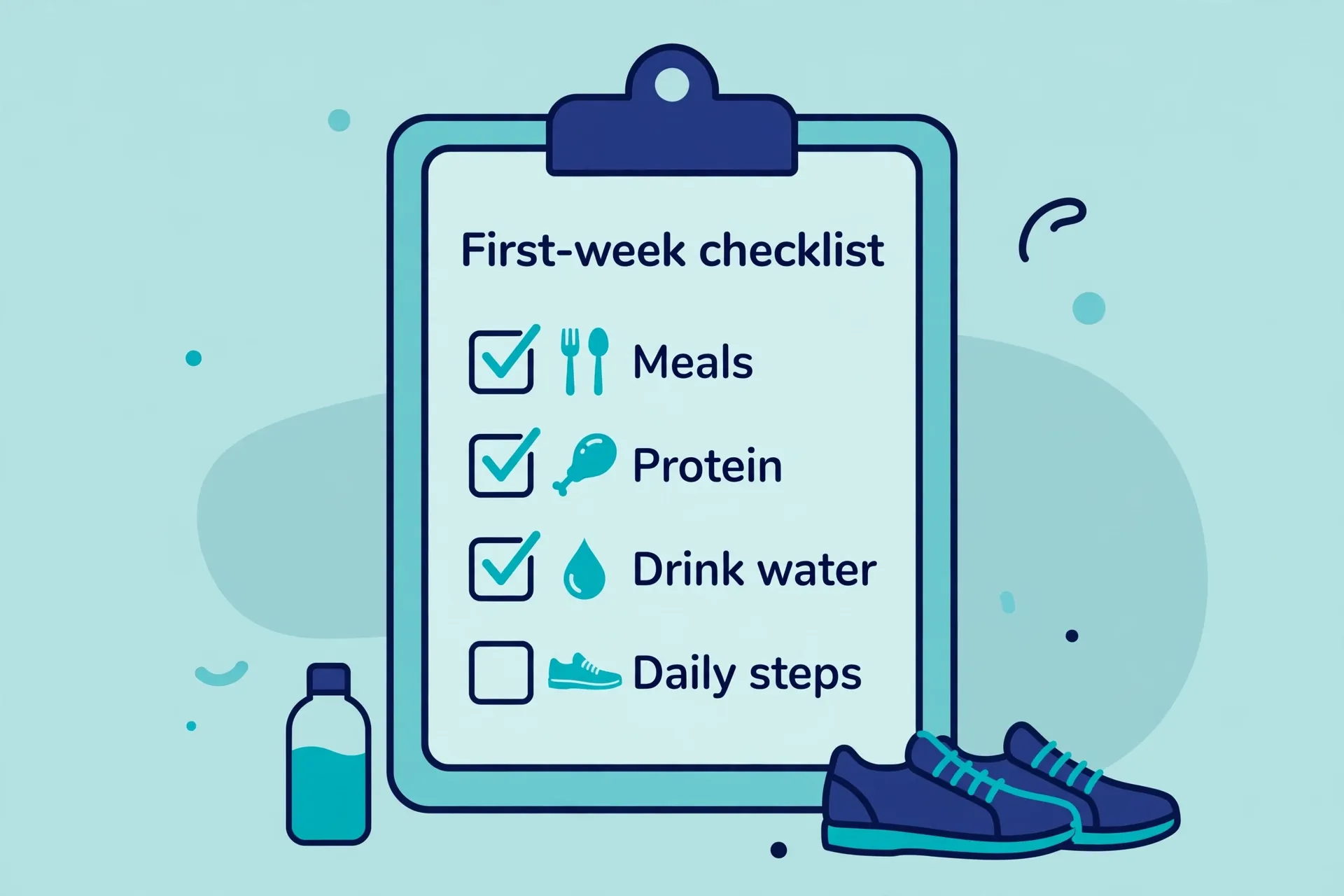
Don’t aim for a perfect week. Aim to finish this list — it builds every skill the deficit needs, one at a time.
- [ ] Day 1: Write down everything you eat, without changing anything. This is your baseline — data, not judgment.
- [ ] Day 2: Add one protein source to the meal that’s currently missing it (eggs at breakfast, chicken at lunch, lentils at dinner).
- [ ] Day 3: Swap one sugary drink for water, black coffee, or tea. Just one.
- [ ] Day 4: Take a 20–30 minute walk after your biggest meal.
- [ ] Day 5: Make half of one plate vegetables. Notice how full you feel.
- [ ] Day 6: Weigh and log your cooking oil and one snack — the two most underestimated items in any kitchen.
- [ ] Day 7: Weigh yourself (morning, same conditions), compare the week, and pick one change to keep for week two.
That’s it. Seven days, seven small wins, zero misery — and you’ll know more about your eating than 90% of people who’ve “tried dieting” for years.
The Bottom Line
Being in a calorie deficit isn’t a project with a start and end date — it’s a slightly smaller energy budget you run until the goal is met, built from protein, vegetables, honest tracking, and daily movement. Protect the small habits that make a sustainable calorie deficit possible — protein at every meal, daily steps, and sleep — and the number on the scale takes care of itself.
Start with the checklist above. Adjust based on the trend, not your mood. And when the deficit feels hard, shrink the deficit — not your life.
Frequently Asked Questions
Do I need to count calories forever?
No — counting is a calibration tool, not a lifestyle. Most people track for 4–12 weeks to learn what portions actually contain, then shift to the plate method, protein habits, and hunger awareness. The goal is internalized fluency: you keep the habits, drop the spreadsheet.
What is the 3-3-3 rule for weight loss?
There is no evidence-based 3-3-3 rule in nutrition science — it’s a social-media heuristic with several competing definitions and no research behind it. Ignore it. A moderate deficit, adequate protein, and consistent habits are the validated framework; they just don’t fit in a catchy number.
Does drinking water help you lose weight?
Modestly, and mostly indirectly. Drinking water before meals reduces how much people eat at that meal in controlled studies, and replacing sugary drinks with water removes hundreds of empty calories a day. It won’t create a deficit on its own, but it’s one of the cheapest supports for one.
Can I have cheat meals in a calorie deficit?
Yes, if they’re planned. One higher-calorie meal a week barely dents a consistent deficit — a 500-calorie surplus one evening against a 3,500 weekly deficit is a rounding error. The danger is the unplanned cheat weekend, which can erase five good days. Plan it, log it, enjoy it, move on.
Can I eat carbs in a calorie deficit?
Absolutely. Carbs aren’t the enemy of a deficit — excess calories are. Whole-food carbs like oats, rice, potatoes, and fruit are some of the most filling foods per calorie you can eat. What derails people is refined carbs plus fat (pastries, fries, desserts), which pack huge calories into small, unsatisfying portions.
Is a calorie deficit the same as a diet?
Not quite. A diet is a set of food rules; a calorie deficit is an energy state — burning more than you eat. You can be in a deficit while eating foods no “diet” would allow, as long as the total stays under your burn. The deficit is the mechanism; the diet is just one way to get there.
Disclaimer
This calculator and the information on this page are for general education and are not medical advice. Results are estimates. Talk to a doctor or registered dietitian before you change your diet, especially if you have a medical condition, take medication, are pregnant or breastfeeding, or have a history of disordered eating.
Reviewed by: Calorie deficit calculator team October 2026
Source: Conversion of calorie deficit to weight loss based on energy balance and the guideline value of approximately 7700 kcal per kg of body fat
Published: October 2026
Status: January 2026
Data protection: All entries are processed exclusively in your browser and are not transferred to us or third parties.




One Comment