What Is a Calorie Deficit? How It Works and How to Calculate Yours
A calorie deficit is the gap between the calories you eat and the calories your body burns in a day. To calculate yours, subtract the calories you eat from your maintenance calories (TDEE). If you burn 2,000 and eat 1,500, your deficit is 500 calories a day. Most adults aim for 300 to 500.

How does a calorie deficit work?
Your body needs a certain amount of energy each day, called your total daily energy expenditure (TDEE). If food supplies less than that, the shortfall comes from energy stored in your body. Most of that store is body fat, and some comes from glycogen and, if protein is low, muscle.
This is the principle of energy balance. Calories in below calories out leads to weight loss over time, calories in equal to calories out keeps weight steady, and calories in above calories out leads to weight gain. The principle is simple. Measuring both sides accurately is not, which is why every calorie target is an estimate.
| State | Intake compared with TDEE | Result over time |
|---|---|---|
| Calorie deficit | Below | Weight loss |
| Maintenance | About equal | Weight stays steady |
| Calorie surplus | Above | Weight gain |
What is the calorie deficit formula?
Calorie deficit = Maintenance calories (TDEE) − Calories eaten
A positive result is a deficit. A negative result is a surplus. To plan a target instead of measuring one, rearrange it:
Daily calorie target = TDEE − Planned deficit

How do I calculate my calorie deficit step by step?
- Find your BMR. Use the Mifflin-St Jeor equation: 10 × weight in kg + 6.25 × height in cm − 5 × age, then add 5 for men or subtract 161 for women.
- Multiply by an activity factor from 1.2 (sedentary) to 1.9 (extra active). The result is your TDEE, or maintenance calories. The TDEE calculator does steps 1 and 2 for you, and how to calculate maintenance calories explains the method in full.
- Choose a deficit. For most adults, 300 to 500 calories a day, or 10 to 25 percent of TDEE.
- Subtract it from your TDEE to get your daily calorie target.
- Check your result against the minimum levels in how many calories should I eat a day. If the target is lower, shrink the deficit.
To skip the maths, use the calorie deficit calculator.
How do I know my deficit is working?
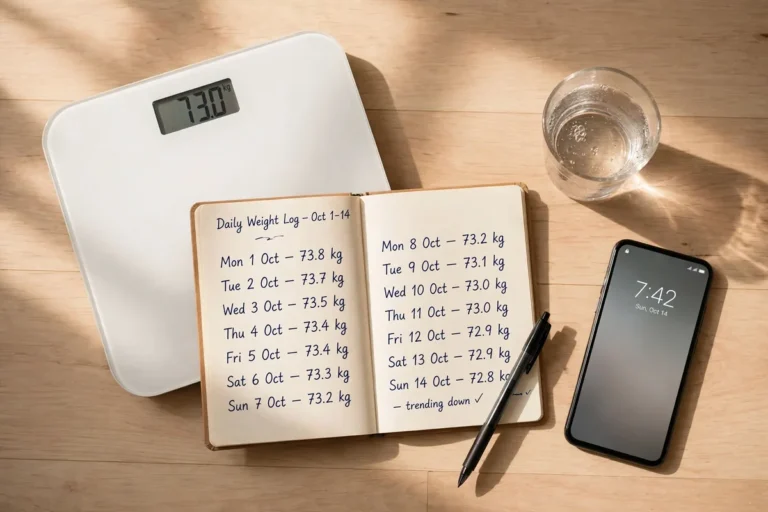
Track your weight at the same time of day, several times a week, and look at the average across two to three weeks. If the average falls by 0.5 to 1 pound (0.25 to 0.5 kg) a week, the deficit matches your plan. If it does not, see not losing weight in a calorie deficit.
What does the calculation look like with real numbers?
| Step | Example A: woman, 35, 165 cm, 75 kg | Example B: man, 40, 180 cm, 90 kg |
|---|---|---|
| 1. BMR | 10 × 75 + 6.25 × 165 − 5 × 35 − 161 = 1,445 | 10 × 90 + 6.25 × 180 − 5 × 40 + 5 = 1,830 |
| 2. TDEE | 1,445 × 1.375 = 1,987 | 1,830 × 1.55 = 2,837 |
| 3. Chosen deficit | 500 calories | 500 calories |
| 4. Daily target | 1,987 − 500 = 1,487 | 2,837 − 500 = 2,337 |
| Expected loss | About 1 pound (0.45 kg) a week | About 1 pound (0.45 kg) a week |
Calculate the deficit from what you already eat
Track your food for several typical days, average the calories, and subtract the average from your TDEE. If Example A eats 1,700 calories a day, her deficit is 1,987 − 1,700 = 287 calories. That is a mild deficit and would produce roughly 0.6 pound (0.3 kg) of loss per week.
To turn a deficit into expected weekly loss, multiply by 7 and divide by 3,500. For a 287-calorie deficit: 287 × 7 = 2,009 calories, and 2,009 ÷ 3,500 = 0.57 pounds.
Does exercise count towards the deficit?
Yes, if you did not include it in your activity factor. If your TDEE already assumes you train three days a week, the calories from those sessions are in it, and adding them again would count them twice. For a one-off extra workout, you can add the estimated calories burned to that day’s deficit, remembering that fitness trackers often overestimate.
Common mistakes when calculating a deficit
- Choosing an activity level that is too high.
- Using an old weight. Recalculate after every 10 to 15 pounds lost.
- Forgetting drinks, oils and snacks when tracking intake.
- Applying the 3,500-calorie rule to months of loss without adjusting. See the 3,500-calorie rule.
- Setting a target below the minimum calorie levels.
How big should a calorie deficit be?
A deficit of 10 to 25 percent of your maintenance calories is a common range, which for most adults means about 300 to 500 calories a day. To find your percentage, divide the deficit by your TDEE and multiply by 100. The same number of calories is a bigger cut for a smaller person:
| Deficit | Example A (TDEE 1,987) | Example B (TDEE 2,837) |
|---|---|---|
| 250 calories | 13 percent of TDEE | 9 percent of TDEE |
| 500 calories | 25 percent of TDEE | 18 percent of TDEE |
| 750 calories | 38 percent of TDEE | 26 percent of TDEE |
A 500-calorie deficit is reasonable for Example B but already at the top of the range for Example A, who would eat 1,487 calories. A 750-calorie deficit would put Example A at 1,237 calories, close to the lowest level generally advised without supervision. This is why a percentage often fits better than a fixed number.
Ways to create a calorie deficit
There are three, and they combine.
- Eat less: reduce portions, swap high-calorie foods and drinks for lower-calorie ones. This is the largest lever for most people.
- Move more: add walking, training or general daily activity to raise your TDEE.
- Both: a small food cut plus more movement is often easier to hold than a large cut alone.
Practical methods are in how to be in a calorie deficit.
How fast will I lose weight in a calorie deficit?
A 500-calorie daily deficit usually produces about 1 pound (0.45 kg) of loss per week at first. The early weeks often show faster loss because the body sheds stored carbohydrate and the water bound to it. After that, loss slows as your body gets lighter and needs fewer calories. The 3,500-calorie rule explains why.
Is a calorie deficit the only thing that matters for weight loss?
A calorie deficit is required for fat loss, but it is not the only thing that affects results. Protein intake, strength training, sleep, stress and how well you can stick to the plan all change how much of the weight you lose is fat and how long you keep it off. Two people in the same deficit can look different after 12 weeks.
Why can the numbers be wrong?
Both sides of the equation are estimates. Calorie targets come from equations that can be off by a few hundred calories a day, and food labels in the United States are allowed a margin of error of up to 20 percent. People also tend to underreport what they eat and overstate how much they burn in exercise. Treat any deficit as a starting point and adjust by weight trend over two to three weeks. If the scale is not moving, see not losing weight in a calorie deficit.
Risks of a calorie deficit
A moderate deficit is safe for most healthy adults. A very large or long deficit can cause muscle loss, tiredness, poor nutrition, gallstones and, in some people, an unhealthy relationship with food. Do not eat below the minimum calorie levels in how many calories should I eat a day without medical supervision.
Frequently asked questions
What does it mean to be in a calorie deficit?
It means you are eating fewer calories than your body burns. Your body then draws on stored energy, which leads to weight loss over time.
Is a 500-calorie deficit good?
For most adults, yes. It usually gives about 1 pound (0.45 kg) of loss per week and is manageable. Smaller or lighter people may do better with 250 to 350 calories.
Can you lose weight without a calorie deficit?
Not body fat in any lasting way. Scale weight can change from water, but fat loss needs you to use more energy than you take in.
Do you lose weight faster with a bigger deficit?
Yes at first, but a bigger deficit raises the risk of muscle loss, hunger, rebound eating and quitting. A moderate deficit you can hold usually beats an aggressive one you cannot.
How long should I stay in a calorie deficit?
Until you reach your goal weight, with regular check-ins. If you feel unwell, lose strength or stall for a month, take one to two weeks of maintenance.
Do I need to count calories to be in a deficit?
No, but counting makes the deficit measurable. You can also reduce portions, add protein and fibre, and cut liquid calories, then check your weight trend.
What is the difference between a calorie deficit and a calorie surplus?
A deficit means eating below your maintenance calories, which leads to weight loss. A surplus means eating above them, which leads to weight gain.
How do I calculate a calorie deficit for weight loss?
Find your TDEE, choose a deficit of 300 to 500 calories, and subtract it to get your daily target. Use the calorie deficit calculator to do it in one step.
How do I calculate a 500-calorie deficit?
Subtract 500 from your maintenance calories. If you burn 2,300, eat about 1,800.
How do I calculate a calorie deficit without a calculator?
Use the Mifflin-St Jeor formula by hand, multiply by an activity factor, and subtract your deficit. The steps above show the maths.
How do I calculate a calorie deficit with exercise?
If your activity level already includes planned exercise, do not add it again. For extra, unplanned sessions, add a conservative estimate of the calories burned to that day.
How many calories is a 20 percent deficit?
Multiply TDEE by 0.2. For a TDEE of 2,000 that is 400 calories, so you would eat 1,600.
How accurate is a calorie deficit calculation?
It is an estimate. Equations and trackers can be off by a few hundred calories, so confirm with your weight trend over two to three weeks.