
How to Calculate Maintenance Calories: The Two-Step Method
Written by Elise Ava · Last reviewed 21 October 2026
Learning how to calculate maintenance calories takes about ten minutes and one honest look at your week. In short: you calculate maintenance calories by estimating your resting burn with the Mifflin-St Jeor equation, then multiplying by an activity factor. The result is your TDEE — the daily intake that holds your weight steady.
This guide teaches the full method by hand, with a worked example, honest activity multipliers, and a way to check the answer against your own body.
The two-step method, in short
Every method worth trusting comes down to the same two moves. First, estimate what your body burns at rest — that’s your basal metabolic rate, or BMR. Then multiply it by an activity factor between 1.2 and 1.9 that reflects how you actually live.
That’s the whole method: TDEE = BMR × activity multiplier. Your TDEE is the intake at which your weight should hold steady — no separate maintenance formula exists, because this is the maintenance math.
Is TDEE just a fancier name for this number?
Yes. TDEE — total daily energy expenditure — is the technical term for the calories your body spends in a full day, and the intake that matches it is what holds your weight steady. Two labels, one number. So when this guide talks about finding your TDEE, it’s teaching you the same thing.
The twin page on this site is the tool that does this arithmetic for you — more on that at the end.
Step 1 — Estimate your resting burn with Mifflin-St Jeor
Your basal metabolic rate is what you burn doing absolutely nothing: breathing, circulating blood, keeping your brain and organs running. For most adults it makes up 60–70% of the day’s total burn, which is why step one carries most of the weight.
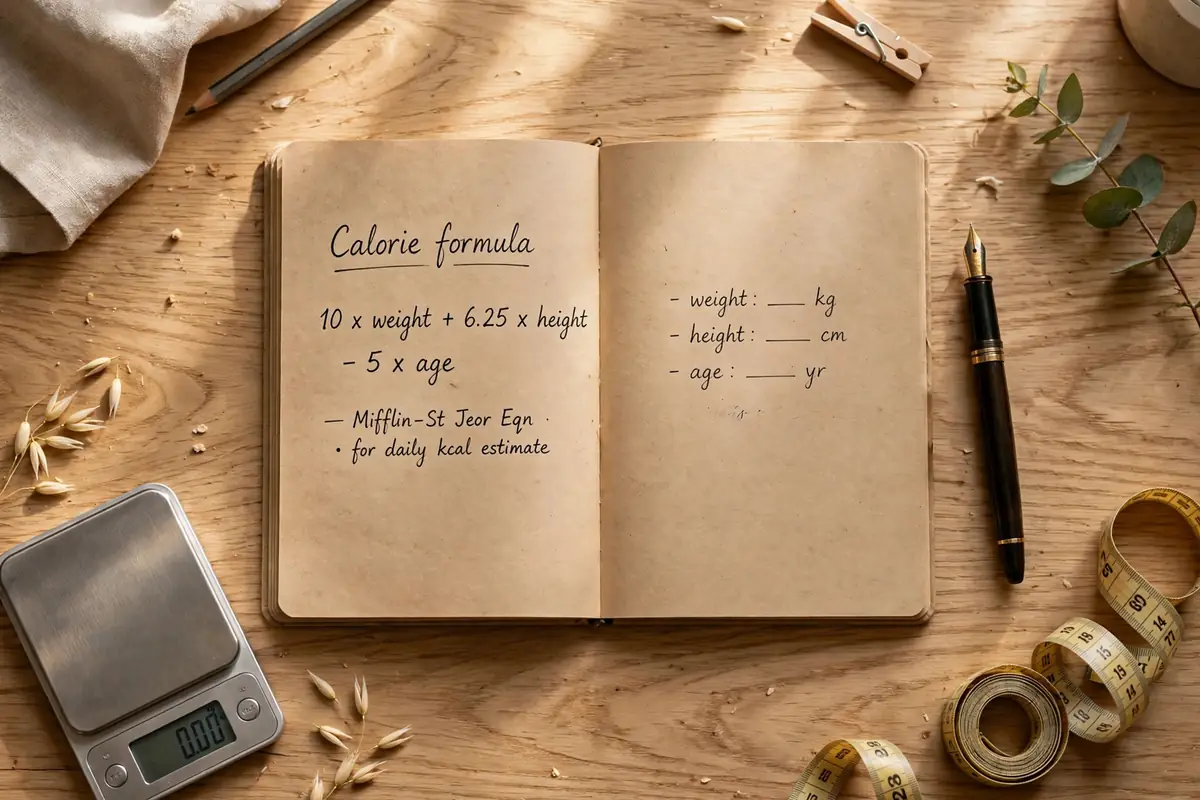
The equation most dietitians reach for is Mifflin-St Jeor, published in 1990. You need four inputs: sex, age, weight in kilograms, and height in centimetres.
Men: BMR = (10 × weight in kg) + (6.25 × height in cm) − (5 × age) + 5
Women: BMR = (10 × weight in kg) + (6.25 × height in cm) − (5 × age) − 161
You can run this whole formula on paper in about ten minutes — a pocket calculator and your real measurements are all it takes.
The equation earned its reputation honestly. Mifflin and colleagues measured resting energy expenditure by indirect calorimetry in 498 healthy adults — 251 men and 247 women, aged 19 to 78, spanning normal weight through obesity — and built the equation from those measurements, not from theory. In the same study, the older Harris-Benedict equations from 1919 overestimated measured resting burn by about 5%.
A 2005 systematic review by Frankenfield and colleagues compared the major equations head-to-head and found Mifflin-St Jeor the most reliable: it predicted resting metabolic rate within 10% of the measured value in more non-obese and obese adults than any other equation, with the narrowest error range. A separate validation in 130 adults found it landed within 10% for roughly 4 out of 5 people — good, not perfect, and worth checking against your own trend later.
Step 2 — Multiply by your activity factor
Step one gave you the at-rest number. Step two scales it to a full day: your job, your steps, your training, your chores — everything. This is the step where most estimates go wrong, because people grade their best week instead of their normal one.
| Multiplier | Level | What it honestly looks like |
|---|---|---|
| 1.2 | Sedentary | Desk job, driving commute, under ~5,000 steps a day, no planned exercise |
| 1.375 | Lightly active | Desk job plus 1–3 workouts a week, or roughly 5,000–7,500 daily steps |
| 1.55 | Moderately active | 3–5 training sessions a week with an active day, around 7,500–10,000 steps |
| 1.725 | Very active | Physical job plus regular training, or roughly 10,000–12,500 steps a day |
| 1.9 | Athlete level | Manual labour combined with training, or twice-daily sessions |
One rung on this ladder is worth a lot. On a resting burn of 1,360 calories, moving from “lightly” to “moderately” active adds about 238 calories a day. That single choice matters more than any decimal in your height — it’s the biggest lever in the whole method.
When you’re torn between two levels, pick the lower one. A desk worker who trains three times a week is usually “lightly active,” not “moderately active” — three gym hours barely dent a 168-hour week. A quick honesty check: pull up your phone’s step count for last week. Under 5,000 a day with no training is sedentary, whatever your intentions were.
Do I eat fewer calories on days I don’t exercise?
No. The multiplier already averages your whole week — training days, rest days, and lazy Sundays are all baked in. Eat the same daily number and judge it by your weekly weight trend, not by the calendar. Cycling your intake day by day adds bookkeeping without adding accuracy.

A full worked example: Daniel’s 2,650
Meet Daniel. He’s 45, weighs 82 kg, is 178 cm tall, supervises a warehouse on his feet all day, and trains twice a week.
Step 1 — his BMR. (10 × 82) + (6.25 × 178) − (5 × 45) + 5 = 820 + 1,112.5 − 225 + 5 = 1,712.5, call it 1,713 calories a day at rest.
Step 2 — his TDEE. His week fits “moderately active,” so 1,713 × 1.55 = 2,655 — round it to 2,650 calories a day. That’s the intake that should hold his weight steady.
Here’s a cross-check you can do in your head: take your weight in pounds and multiply by 15. Daniel is about 181 lb, and 181 × 15 = 2,715 — within shouting distance of 2,650. This shortcut (the 14–16 range for most adults) is a sanity check, not a replacement; when it disagrees with the two-step method by more than ~200 calories, trust the method and then verify with the 2-week test below.
Quick-reference: your number by body weight and lifestyle
Sometimes you want a ballpark before doing the full math. These ranges are computed with the same two-step method, using typical heights and ages — use them as orientation, then run your own numbers.
| Profile | Sedentary | Lightly active | Moderately active | Very active |
|---|---|---|---|---|
| Woman, 35, 130 lb, 5’4″ | ~1,550 | ~1,750 | ~1,950 | ~2,200 |
| Man, 40, 160 lb, 5’9″ | ~1,950 | ~2,250 | ~2,500 | ~2,800 |
| Woman, 50, 200 lb, 5’6″ | ~1,850 | ~2,100 | ~2,400 | ~2,650 |
| Man, 30, 220 lb, 6’0″ | ~2,400 | ~2,750 | ~3,100 | ~3,450 |
Two people at the same weight can still differ by 200–400 calories a day — muscle mass, everyday fidgeting, and plain individual variation all move the needle. The table shows where you probably are; your own trend data shows where you actually are.
Why does every site give me a different number?
Two reasons. First, sites use different resting equations — older pages still run Harris-Benedict from 1919, which overestimates, while newer ones use Mifflin-St Jeor. Second, each site defines its activity levels differently, and one level is worth ~240 calories a day. The fix is the same: treat it as a starting estimate, then correct it with the 2-week test below.
The 2-week test: measure your maintenance calories directly
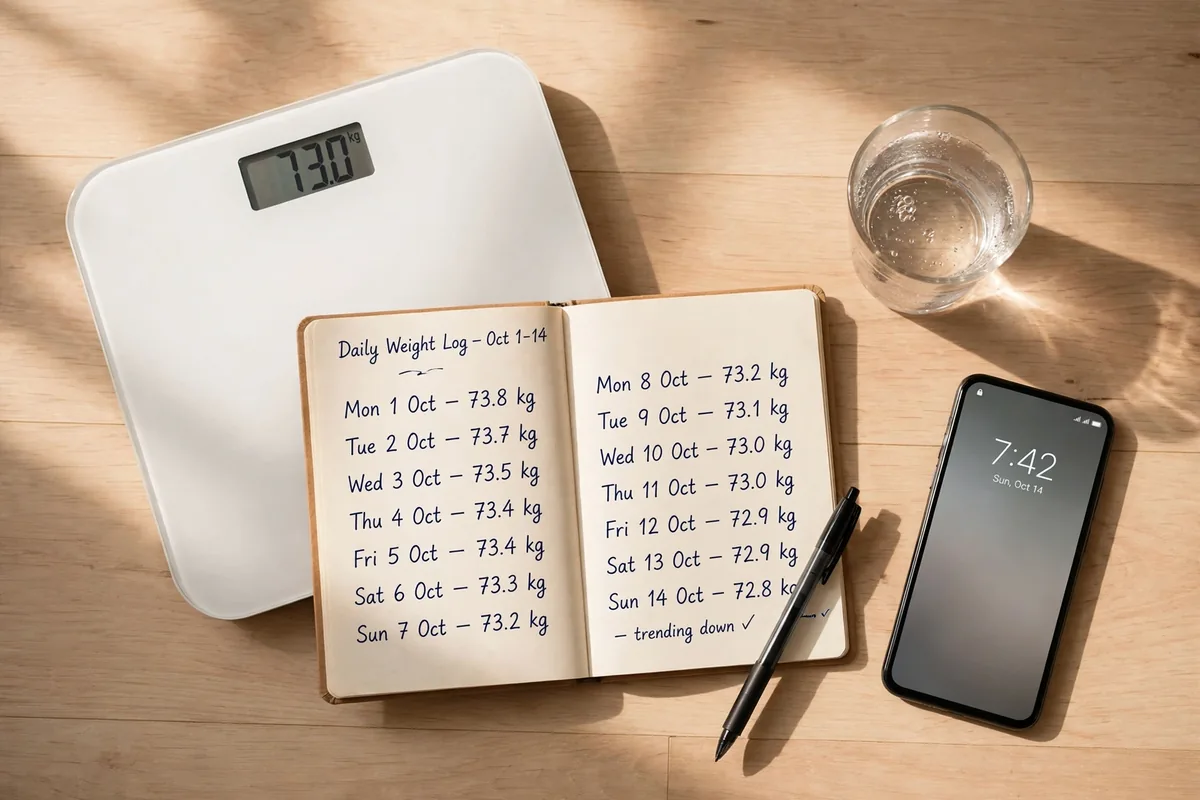
Formulas estimate; your scale measures. The most reliable way to pin down your number needs no equation at all:
This measured figure is your true maintenance calories — no formula needed. It usually lands within about ±5% of a careful two-step estimate, and from there it’s more accurate than any equation, because it’s built from your body, not a population average.
Two things make this test easier than it sounds. First, think in ranges, not dots: your body has a buffer of roughly 100–200 calories, and it quietly compensates — a little more fidgeting here, a touch more warmth there — when you overshoot slightly. Maintenance is a band, not a bullseye.
Second, non-exercise movement (NEAT) is the wild card. In controlled chamber studies from the Mayo Clinic’s James Levine and colleagues, spontaneous everyday movement varied from about 100 to 800 calories a day between people of similar size. That’s why two people with identical stats can maintain on numbers hundreds of calories apart — and why your own trend beats every formula.
Two myths that skew the math
“My metabolism crashed in my thirties.” Probably not. A 2021 study in Science measured total daily energy expenditure with the gold-standard doubly labeled water method in more than 6,400 people across 29 countries — and found that size-adjusted expenditure stays remarkably stable from age 20 to 60, only declining about 0.7% per year after 60. Midlife weight gain tracks far better with shrinking daily movement and shifting habits than with an aging furnace.
“Muscle burns 50 calories a pound.” Measured values land closer to about 6 calories per pound per day at rest. Building muscle is still worth it — it changes how you look, how strong you are, and how your body handles food — but a few extra kilos of muscle won’t move your daily number by hundreds of calories.
Put the number to work
Once you have your anchor, every other calorie goal is just arithmetic from it. Searchers often type “maintenance calorie calculator” — that’s simply this two-step method with the arithmetic done for you. If you’d rather skip the hand calculation, our TDEE calculator runs the exact same steps — Mifflin-St Jeor, then your activity factor — and gives you the instant result.
And when you’re ready to turn that anchor into a loss target, read how to calculate a calorie deficit: the guide walks through subtracting a chosen amount from this number and picking a deficit size safely. Most people start 500–1,000 calories below their anchor per day — the CDC’s long-standing range for losing roughly 1–2 lb a week.
Recalculate your maintenance calories after about 5 kg of weight change, or whenever progress stalls for three weeks despite honest tracking. Your number is a living estimate, not a tattoo.
Frequently Asked Questions
How many calories do I need to hold my weight if I don’t exercise?
It depends on your size, not just your stillness. A smaller sedentary adult might hold steady near 1,600 a day; a taller, heavier one might need 2,200. The two-step method gives you your own figure — “no exercise” just means you use the 1.2 sedentary multiplier in step two.
Should I add back the calories I burn in a workout?
No — if your workouts were already counted in your activity factor, adding them back double-counts. You only “eat back” exercise calories if you deliberately used the sedentary multiplier and want to add training on top. One system or the other, never both.
Does gaining muscle raise my daily number?
A little. Muscle costs roughly 6 calories per pound per day at rest, so adding 5 lb of muscle moves your number by about 30 calories — real, but small. Muscle matters far more for strength, shape, and how you look than for the calorie math.
How often should I redo the calculation?
After every ~5 kg of weight change, when your job or training routine changes, or when your weight trend stalls for three weeks despite consistent eating. Rechecking takes ten minutes and keeps every goal built on the number honest.
Can I find my number without weighing my food?
Roughly, yes. The 2-week test only needs consistent eating and daily weigh-ins — your weight trend reveals whether your current intake holds you steady, even without a food scale. Precision helps, but the trend is the real judge.
Disclaimer
This calculator and the information on this page are for general education and are not medical advice. Results are estimates. Talk to a doctor or registered dietitian before you change your diet, especially if you have a medical condition, take medication, are pregnant or breastfeeding, or have a history of disordered eating.