
How Many Calories to Lose Weight? Your Personal Daily Target
Written by Elise Ava · Last reviewed 23 October 2026
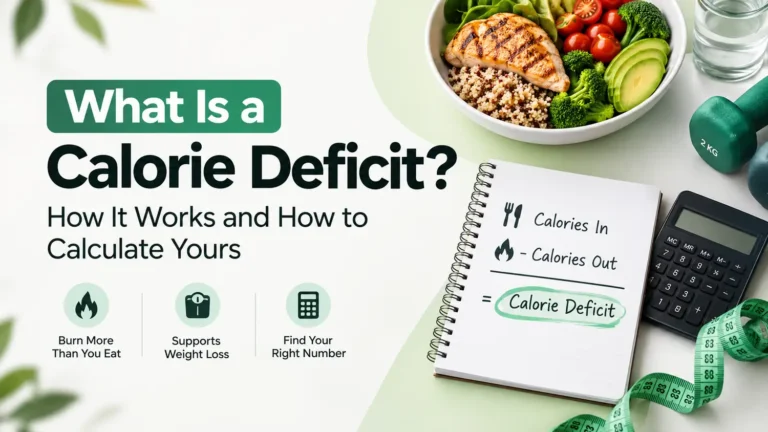
How many calories to lose weight? It’s the most-asked question in weight loss, and the honest answer is a personal number: your total daily burn (TDEE) minus about 500. That gap — a daily calorie target for weight loss — is what turns eating into fat loss, roughly half a kilo a week, without crash dieting.
No single number fits everyone. A 90 kg man and a 60 kg woman don’t burn the same calories, so they don’t lose on the same intake. This guide gives you the three-step method to find your number, a lookup table by weight and activity, a worked example with real arithmetic, and the weekly loss each target produces.
Once you have your number, read how to be in a calorie deficit to live it day to day — and if you’re unsure how aggressive to go, see what your calorie deficit should be.
How Many Calories to Lose Weight Each Day: The Short Answer
Take what your body burns in a day and eat about 500 calories less than that. That single rule covers nearly every adult: the CDC’s own weight-loss guidance puts the sustainable pace at 1 to 2 pounds a week, which a daily deficit of 500 to 1,000 calories produces.
For most women that lands somewhere between 1,200 and 1,800 calories a day; for most men, between 1,500 and 2,000. Those ranges come from working backward from typical maintenance burns, not from anyone’s guess — and they’re the starting point, not a prescription. If the mechanics of the deficit itself are new to you, our guide to the calorie deficit covers how the gap actually drives fat loss; this page is the applied part — your number.
Finding Your Weight Loss Calorie Target in Three Steps
Three moves, no app required.
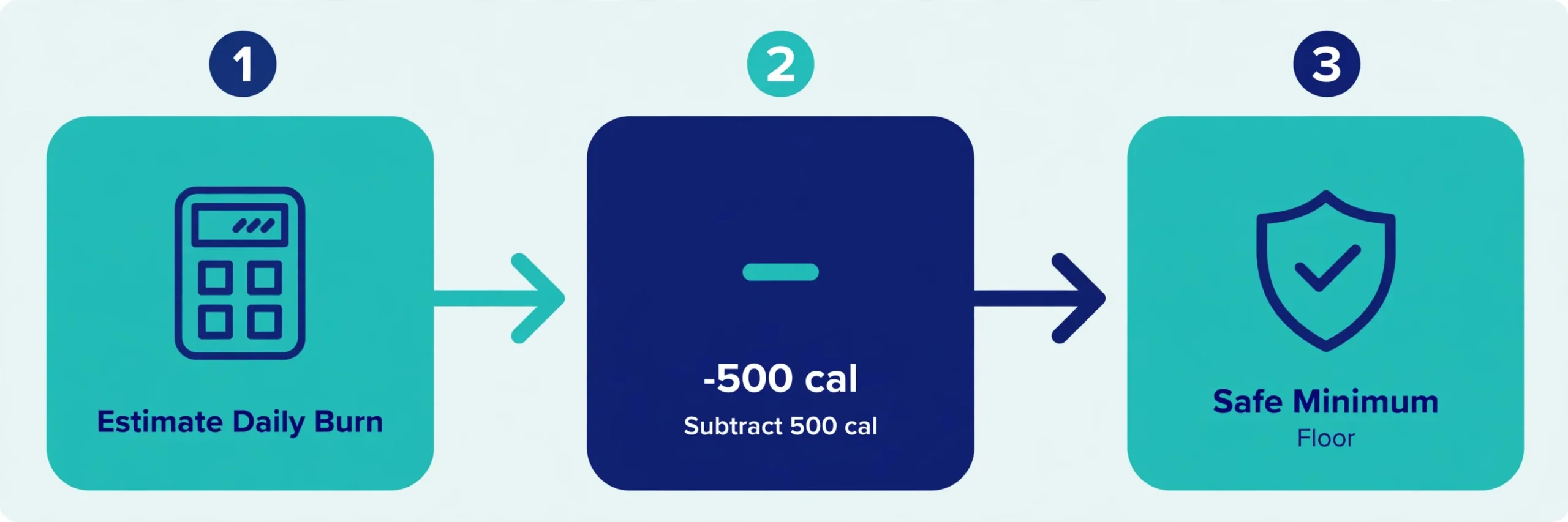
Step 1: Estimate what you burn. Your maintenance number (TDEE) is your basal metabolic rate — what you’d burn lying still all day — times an activity multiplier from 1.2 (desk-bound) to 1.9 (physical job or daily hard training). The Mifflin-St Jeor equation is the standard estimator dietitians still use:
Women: BMR = 10 × weight (kg) + 6.25 × height (cm) − 5 × age − 161
Men: BMR = 10 × weight (kg) + 6.25 × height (cm) − 5 × age + 5
Pick the activity tier honestly — most people choose one too high. The full method, with every multiplier and a printable walkthrough, lives in our step-by-step guide to calculating a calorie deficit.
Step 2: Subtract 500. That number is your weight loss calorie target — the intake that should lose you roughly half a kilo (about a pound) a week at the start. It’s the middle of the CDC’s 500–1,000 range: big enough to see on the scale within two weeks, small enough to eat like a normal person.
Step 3: Check the floor. If the subtraction lands below 1,200 a day (women) or 1,500 (men), don’t go there without professional supervision. Those are the commonly cited minimums, sitting at the low end of the ranges in the 2013 AHA/ACC/TOS obesity guideline — below them, getting enough protein, iron, calcium, and fiber gets mathematically difficult.
A Real Example: Maria’s Numbers
Maria is 38, weighs 75 kg, stands 165 cm, and works a desk job with two gym sessions a week — lightly active (× 1.375).
- BMR = 10 × 75 + 6.25 × 165 − 5 × 38 − 161 = 750 + 1,031.25 − 190 − 161 = 1,430 kcal
- TDEE = 1,430 × 1.375 = 1,967 kcal a day to maintain
- Target = 1,967 − 500 = 1,467, rounded to 1,470 kcal a day
At 1,470 a day, Maria’s daily gap is ~500 calories — 3,500 a week — which the classic math converts to about 0.45 kg (one pound) of weekly loss at the start. Sanity check against the USDA’s 2020–2025 guidelines: they put a moderately active woman of 31–50 at about 2,000 calories a day to maintain. Maria is lighter and less active, so 1,967 to maintain and 1,470 to lose both sit exactly where you’d expect.
Do I subtract the deficit from my BMR or my TDEE?
Do I subtract the deficit from my BMR or my TDEE?
From your TDEE — always. Your BMR is only what you’d burn lying still all day, roughly 60–70% of your real burn, so subtracting from it double-counts your activity and lands you hundreds of calories too low. TDEE includes your movement; the deficit comes off that number.
This is the single most common arithmetic mistake on the forums. Someone computes a BMR of 1,400, subtracts 500, and tries to live on 900 — then wonders why they’re dizzy, bingeing, and stalled. The deficit always comes off the full daily burn, never the resting one.
The Daily Target Table
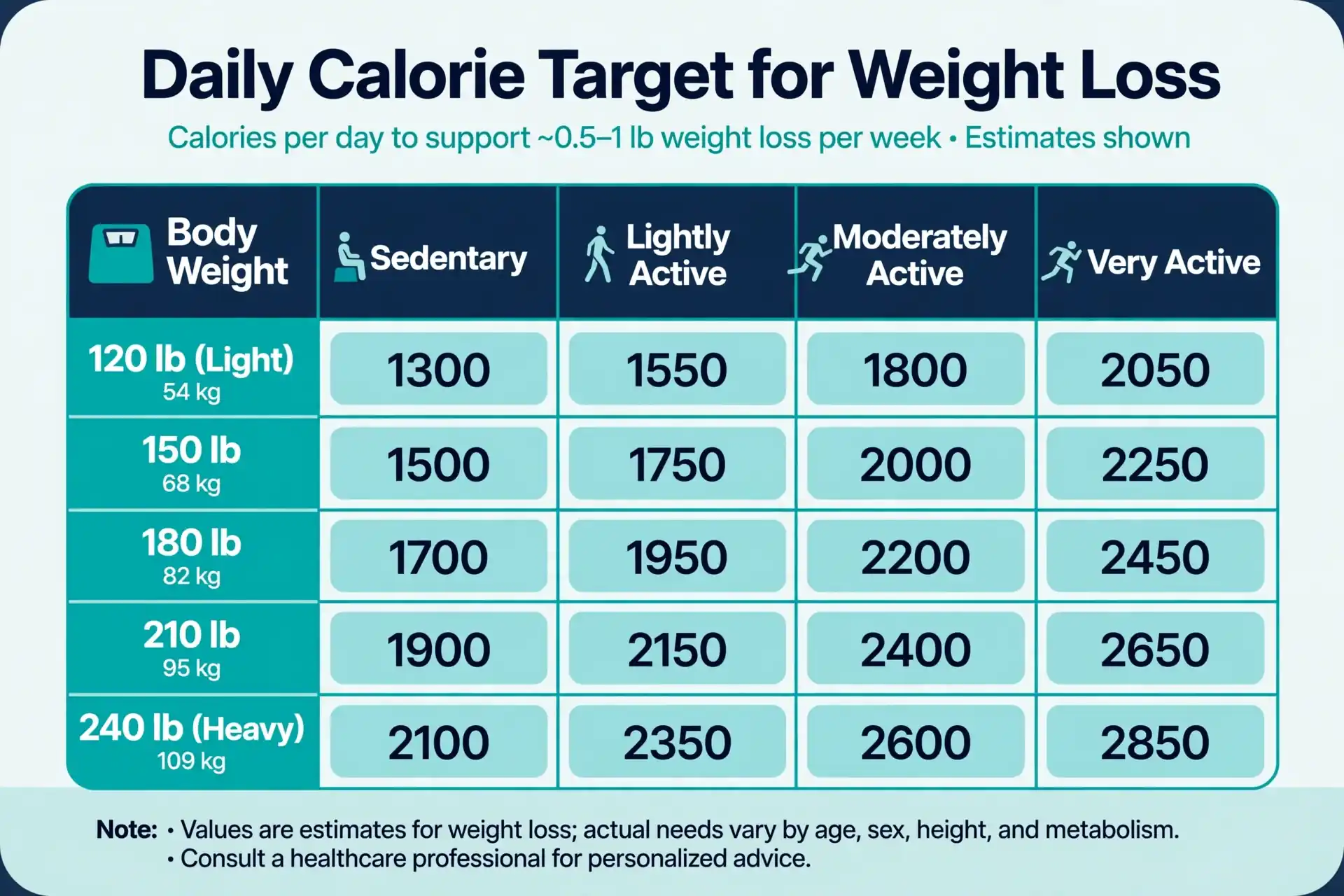
Don’t want to run the formula? Find your row and column. The table assumes a 35-year-old woman at 165 cm, TDEE estimated with Mifflin-St Jeor, minus 500 kcal for roughly half a kilo a week. Men, taller, and younger readers burn more, so treat their column as a conservative starting point and adjust from the scale after three weeks.
| Current weight | Sedentary (×1.2) | Lightly active (×1.375) | Moderately active (×1.55) |
|---|---|---|---|
| 60 kg (132 lb) | 1,200* | 1,280 | 1,510 |
| 70 kg (154 lb) | 1,200* | 1,420 | 1,660 |
| 80 kg (176 lb) | 1,290 | 1,560 | 1,820 |
| 90 kg (198 lb) | 1,410 | 1,690 | 1,970 |
| 100 kg (220 lb) | 1,530 | 1,830 | 2,130 |
| 110 kg (243 lb) | 1,650 | 1,970 | 2,280 |
*The raw math lands below 1,200 here, so the table holds the commonly cited minimum instead of printing a lower number — read the floor section above before going near it.
Two honest notes. First, one person’s “lightly active” is another’s “moderate”: if the column’s number doesn’t move the scale after three honest weeks, you’re in the wrong column, not on the wrong diet. Second, the table is a starting line, not a verdict — it gets you close, and your scale trend does the fine-tuning.
What Each Target Loses You Per Week
Whatever your weight loss calorie target from the table above, this is roughly what the first weeks look like. The conversion uses the classic energy figure: one kilogram of body weight represents about 7,700 kcal, so divide your daily gap by that.
| Daily deficit | Weekly gap | Expected loss (early weeks) |
|---|---|---|
| 250 kcal | 1,750 kcal | ~0.25 kg (~½ lb) |
| 500 kcal | 3,500 kcal | ~0.45 kg (~1 lb) |
| 750 kcal | 5,250 kcal | ~0.7 kg (~1½ lb) |
| 1,000 kcal | 7,000 kcal | ~0.9 kg (~2 lb) |
The word “early” is doing real work in that table, which brings us to the part most guides skip.
Why Weight Loss Slows Down Over Time
The 3,500-calories-per-pound rule dates to 1958, when Max Wishnofsky measured the energy in a pound of fat tissue. It was never meant as a weight-loss forecast, and it quietly assumes two things that aren’t true: that you lose pure fat, and that your burn stays fixed while you shrink.
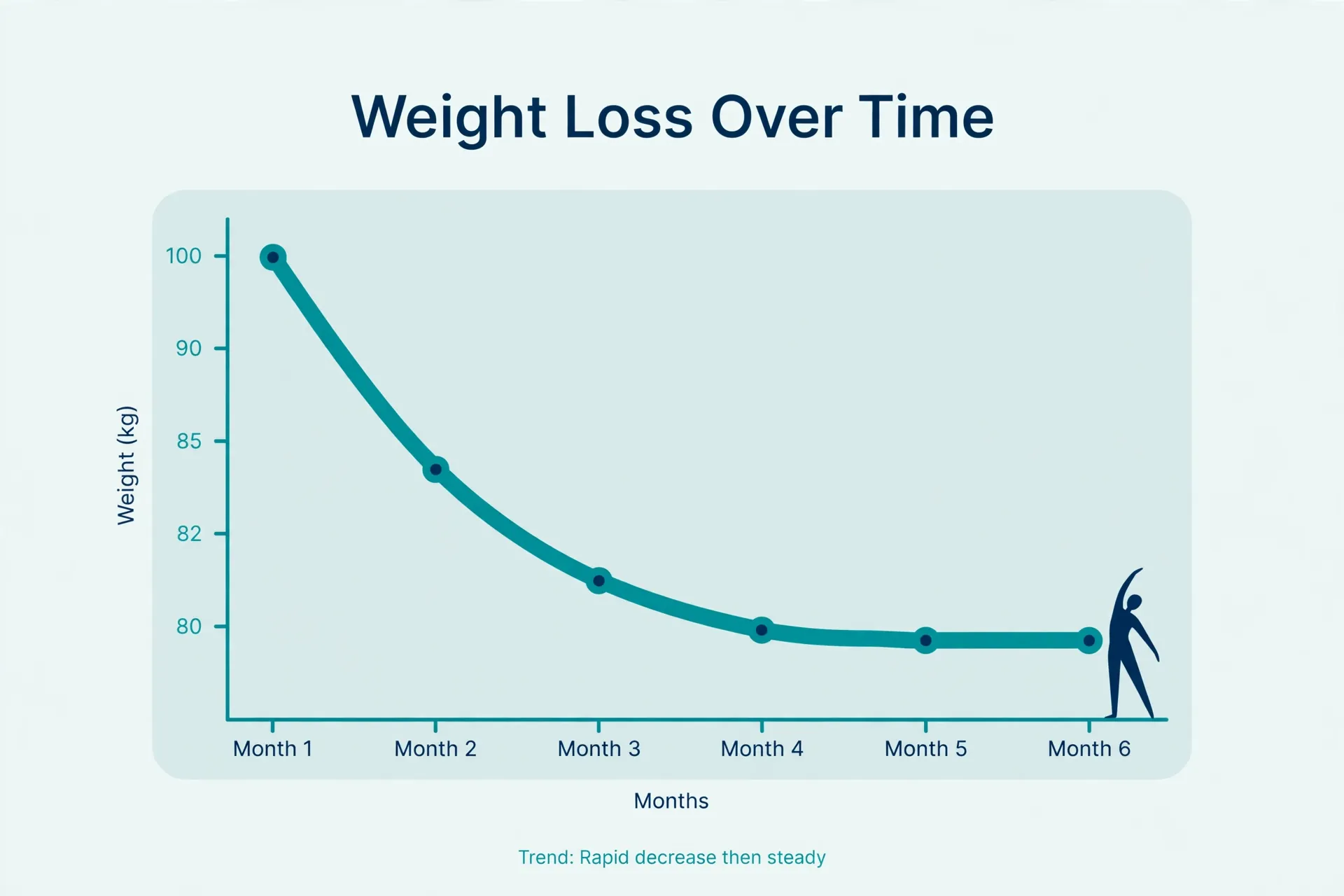
It doesn’t. As you get lighter, your body needs less energy to exist and move — and on top of that, cutting calories triggers a small adaptive slowdown (adaptive thermogenesis), the body’s “famine response” holding onto stored energy. NIH researcher Kevin Hall’s dynamic model of energy balance, published in The Lancet in 2011, showed the old rule overestimates real loss by roughly double over a year when only diet changes. The American Society for Nutrition has since said the 3,500 rule should be abandoned as a predictor.
Hall’s practical replacement is strikingly simple: every permanent 10-calorie cut in daily intake eventually settles at about one pound of loss — but it takes roughly a year to see half of it and up to three years to reach the new equilibrium. Weight loss is a curve that flattens, not a straight line. That’s also why plateaus aren’t a sign the diet “stopped working” — they’re the math of a smaller body. When the scale stalls for three weeks, recalculate your target at your new weight (the table above makes this a 30-second job) rather than slashing further. And for a personalized forecast that models the slowdown, the NIH’s free Body Weight Planner runs Hall’s dynamic model on your own numbers.
Is 1,200 calories too few to lose weight?
Is 1,200 calories too few to lose weight?
For most adults, yes — 1,200 is the commonly cited floor for women and 1,500 for men, not a goal to aim for. Below those intakes it’s hard to get enough protein, iron, calcium, and fiber, and adherence collapses. If your math lands below the floor, shrink the deficit or move more instead.
The forum version of this question is usually “I eat 1,200 and I’m not losing” — which almost always means the 1,200 isn’t real (untracked oils, drinks, and bites add hundreds), or the person’s actual maintenance is lower than the calculator said. Either way the fix is better data, not fewer calories.
Why am I not losing weight eating 1,500 calories a day?
Why am I not losing weight eating 1,500 calories a day?
Usually because one of the two numbers is off. Intake gets underestimated — oils, drinks, bites, and weekend meals slip past the log — or TDEE is overestimated, since most people pick an activity level a tier too high. Log honestly for two weeks, choose the lower activity tier, and compare the scale trend.
Research on food logging backs the suspicion: people underreport intake by a wide margin, and the error grows with portion size. Before cutting calories further, weigh food for a week — a “tablespoon” of oil is routinely two — and compare weekly average weights, not single weigh-ins, since water swings hide fat loss day to day.
Should I eat back the calories I burn exercising?
Should I eat back the calories I burn exercising?
No — not if your target already counted that exercise. Your TDEE multiplier includes your workouts, so adding burned calories back on top erases the deficit twice-counted. The one exception is a huge unplanned effort, like a long hike, where a partial refuel keeps the day reasonable.
There’s a second reason to be skeptical: trackers and machines overestimate exercise burn, often generously. If your target came from an activity multiplier that already includes your training days, the workout calories are spent before you eat them — leave them there.
Your Next Step
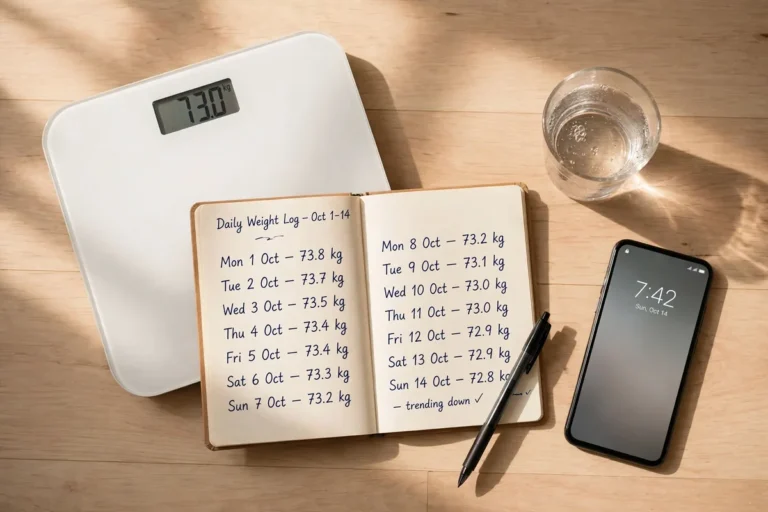
Pick your number from the table, eat it honestly for three weeks, and weigh yourself daily — but judge only the weekly average. If the trend is down roughly half a kilo a week, you’re done calculating; just keep going.
If it’s flat after three honest weeks, don’t slash. First recheck the two usual suspects: the activity column you chose and the calories you aren’t logging. Still flat? Drop the target by 100–200 and give it another three weeks — never below the floor. And when you’ve lost 5–10 kg, come back and re-read the table at your new weight: a smaller body needs a smaller target, and that’s the curve working as designed.
Frequently Asked Questions
How many calories should I eat a day to lose weight?
Eat about 500 calories less than your total daily burn (TDEE). For most women that works out to roughly 1,200–1,800 a day and for most men 1,500–2,000 — but the exact number depends on your weight, height, age, and activity, so use the table above or the three-step method to find yours.
How many calories should a woman eat to lose weight?
Most women lose weight between 1,200 and 1,800 calories a day, with the commonly cited minimum of 1,200 not to be crossed without supervision. A lighter, sedentary woman sits near the bottom of that range; a heavier or active woman near the top — find your row in the table above rather than copying someone else’s number.
Is 1,500 calories a day enough to lose weight?
It depends on your maintenance. At a 2,000-calorie TDEE, 1,500 gives a 500-a-day deficit — about a pound a week. At a 1,700 maintenance it’s only a 300 deficit, closer to half a pound a week. Whether 1,500 “works” is entirely a function of the gap beneath your burn, not the number itself.
How much weight will I lose eating 1,800 calories a day?
Subtract 1,800 from your maintenance to get the answer. With a 2,300-calorie TDEE, that’s a 500 daily deficit — roughly a pound a week at first. With a 2,000 TDEE, it’s 200 a day — under half a pound a week. The intake alone tells you nothing; the gap tells you everything.
Can you lose weight eating 2,000 calories a day?
Yes, if your maintenance is above 2,000. A moderately active man or a heavier woman can easily maintain at 2,500+, making 2,000 a solid 500-calorie deficit. Weight loss cares about the gap between burn and intake, not whether the intake number sounds like a “diet.”
How quickly will I lose weight on 1,200 calories a day?
Faster at first than on a moderate target — but 1,200 is the commonly cited minimum for women, not a recommended plan, and it shouldn’t be attempted without professional guidance. Rapid early drops are mostly water, the pace flattens as the body adapts, and very low intakes risk nutrient shortfalls and rebound.
Disclaimer
This calculator and the information on this page are for general education and are not medical advice. Results are estimates. Talk to a doctor or registered dietitian before you change your diet, especially if you have a medical condition, take medication, are pregnant or breastfeeding, or have a history of disordered eating.
Reviewed by: Calorie deficit calculator team October 2026
Source: Conversion of calorie deficit to weight loss based on energy balance and the guideline value of approximately 7700 kcal per kg of body fat
Published: October 2026
Status: January 2026
Data protection: All entries are processed exclusively in your browser and are not transferred to us or third parties.




5 Comments